Welcome to the Acabado Theme

Why let page speed ruin the user experience and hurt your SEO when you can fix it with Acabado?

Recent Posts

PLC Hardware: A Detailed Overview With Component Examples


PLC Hardware

A PLC (Programmable Logic Controller) is made up of both hardware and software components. The PLC hardware refers to the physical components that make up a PLC system. Whereas the PLC software refers to the PLC’s operating system and application program that are stored in the PLC’s memory.

PLC hardware is a term that describes the physical components that make up the overall PLC system. Each piece of PLC hardware is designed to perform a specific task. Without all of its hardware components a PLC system cannot operate effectively.

Think of the main components that make up a car. The engine, gearbox, wheels, electrics, steering, body etc. Without all of its components a car cannot function properly. And most of the components that are used, say in a Ford, cannot be used in a Honda. In that sense, PLC Hardware is a similar concept.

The majority of PLC manufacturers have developed hardware and software components to establish a proprietary PLC system. That means PLC hardware components vary for different manufacturers and in the majority of cases are not interchangeable with hardware components from other PLC brands.

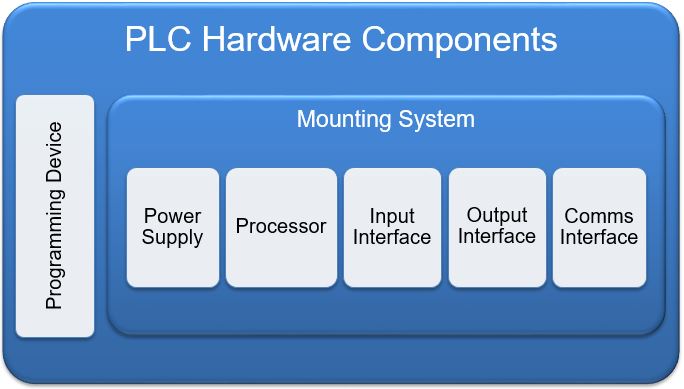
The 6 basic hardware components that make up a PLC are:

  1. Processor (CPU)
  2. Mounting System
  3. Power Supply
  4. Input & Output Interface
  5. Communication Interface
  6. Programming Device

These main PLC hardware components are found in all PLC systems regardless of manufacturer, type and size. They are the essential hardware elements that make up every PLC system.
PLC Hardware Block Diagram

Let’s take a closer look at the major plc components and their functions…

1. PLC Processor (CPU)

At the heart of every PLC system is a processor. It is arguably the most crucial PLC hardware component. Sometimes the PLC processor is also referred as the PLC controller or PLC CPU (Central Processing Unit). Whatever you choose to call this piece of PLC hardware, the PLC processor is the workhorse of the PLC system responsible for all the logic computation and number crunching.

The PLC processor can be embedded into the PLC unit or come as a separate PLC module. Generally fixed PLC types have their processor embedded in the PLC itself. While modular and distributed PLC types have their PLC processors as a separate module.

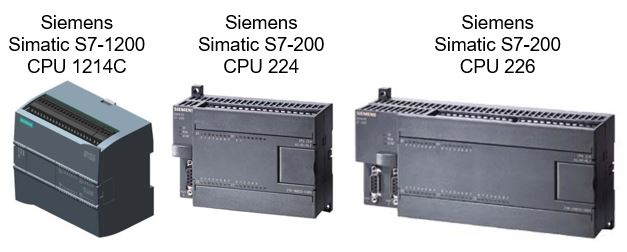
Some examples of PLCs with embedded processors are the Siemens Simatic S7-200 CPU 224, S7-200 CPU 226 and more recently the Siemens Simatic S7-1200, CPU 1214C  (6ES7 214). They are a fixed style PLC with embedded processor, but have the ability to expand with input and output modules. See below….
PLC Processor (CPU) – Embedded in the PLC Unit

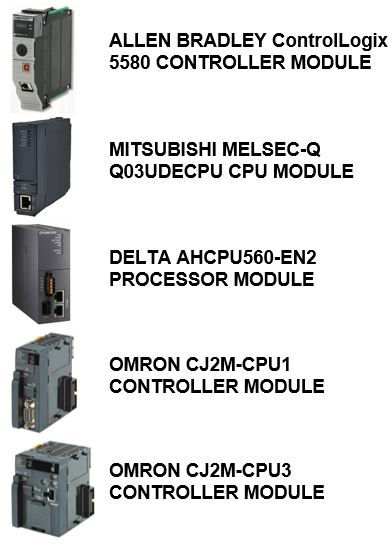
Some examples of PLC processor modules are the Allen Bradley ControlLogix 5580 controller, the Mitsubishi Melsec-Q Processor CPU (Q03UDECPU), the Delta AHCPU560-EN2 processor and the Omron CJ2M-CPU1 and CJ2M-CPU3 controllers.
PLC Processor (CPU) Modules

The PLC processor contains 3 fundamental components:

  • PLC CPU (Central Processing Unit)
  • PLC Memory
  • PLC Programming port

PLC CPU (Central Processing Unit)

The PLC CPU is a microprocessor that is similar to a computer CPU. However, the PLC CPU is not set up to multitask like a computer CPU, but rather to perform dedicated tasks such as program scan and execution.

In a PLC the CPU is responsible for control of all PLC activity. This includes program scanning (such as ladder logic), program executing, handling data storage, directing data flow and controlling communication among the various interfaces.

The most common processor used in a PLC is a single microprocessor. However, the higher powered PLCs have multiple microprocessors to divide up the various tasks in order to improve overall operating speed. A PLC with dual microprocessors could have a control processor to carry out data manipulation and complex computation as well as a second logic processor to execute the logic, timing, counting and other functions of the application program.

PLC Memory

The PLC memory is made up of program memory, data memory and firmware. The PLC uses the memory to store the program for processing by the CPU and to store data for input and output processing and execution.

The size of the PLC memory will vary depending on the processing power of the CPU. You will find that higher powered PLC models will be equipped with faster CPUs and will have more onboard memory.

So if you have a large PLC program then you will require a PLC controller with a large integrated memory capacity to accommodate. Having said that, some PLC controllers have expandable memory which can get you out of trouble if you run out of memory unexpectadly.

PLC Programming Port

The programming port on the PLC processor is used to connect to a programming device such as a PC or laptop. The communication protocol used for the PLC programming port varies between PLC manufacturers. Some examples of the communication protocol used for the PLC programming port includes RS232, RS485 and Ethernet.

2. PLC Hardware Mounting Systems

The hardware mounting system of a PLC provides the means to physically connect the various hardware components of the PLC system. PLC hardware mounting systems can vary from one PLC manufacturer to another and can also vary depending on the type of PLC used.

The 3 main PLC mounting systems used in industrial automation projects are:

  • Rack mounted PLC
  • Rail mounted PLC   
  • Panel mounted PLC

Let’s look at the different mounting systems in a little more detail….

Rack Mounted PLC

A rack mounted PLC uses a mechanical mounting system in order to physically connect the PLC processor and other PLC hardware components together. The most common rack mounted PLCs use an arrangement whereby the hardware components are slotted into the rack. This allow the hardware components to be secured in placed and at the same time connected together, with plugs at the base of the rack, via the PLC bus.

Rack Mounted PLCs are commonly used in modular and distributed type PLC systems. They are well suited to service higher end and plant wide applications where multiple PLC racks and large numbers of inputs and outputs are required. They have a fixed number of hardware module slots and generally have an orderd hardware module layout. Such as power supply module, PLC processor module, communication modules then input and output modules.

An example of a rack mounted PLC is the Siemens Simatic S7-400. The PLC mounting rack, rack slots, PLC bus and PLC modules are clearly labelled. This particular PLC mounting rack has 9 slots, with some PLC hardware modules taking up multiple slots. See below….
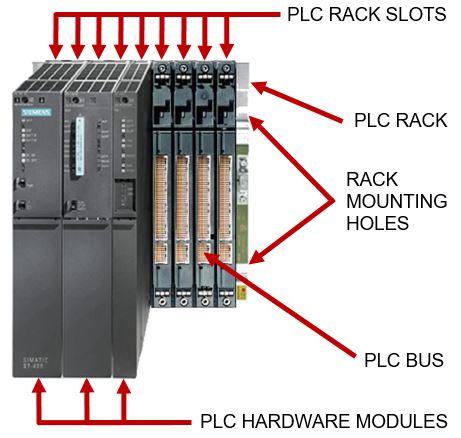
Rack Mounted PLC
Rack Mounted PLC

Some PLC manufacturer use different terminology to describe their rack mounted PLCs. Terms such as chassis, backplane, base, base rack and base module are all examples of different terminology to describe rack mounted PLCs. Siemens uses the term PLC rack for their S7-400 PLC mounting system.

An example of a Siemens PLC rack is shown below…
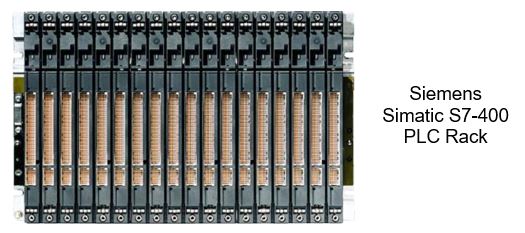
Siemens PLC Rack
Siemens PLC Rack

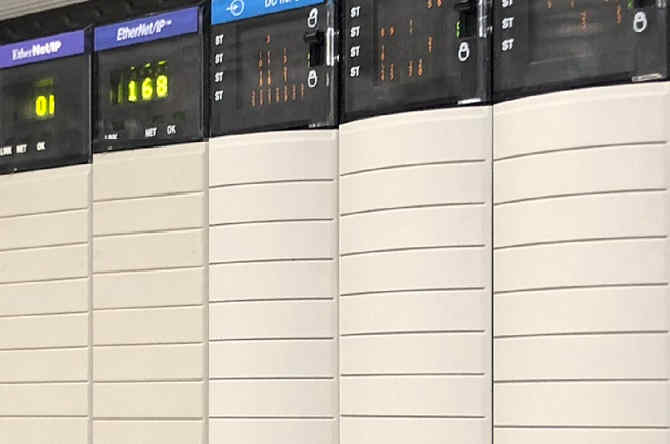
Allen Bradley uses the term PLC chassis for their ControlLogix PLC mounting system. An example of an Allen Bradley ControlLogix chassis is shown below….
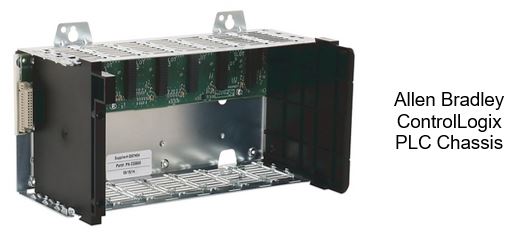
Allen Bradley ControlLogix Chassis

The term PLC backplane is used by the the Omron CS1, Schneider Modicon M340 and Delta AH series PLCs to describe their PLC mounting system. Examples of the Omron CS1 series PLC backplane, Delta AH Series PLC back plane and Modicon M340 backplane are shown below…
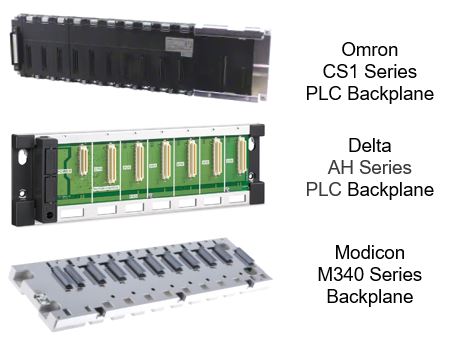
PLC Backplane
PLC Backplane

Koyo, Toshiba and Yokogawa use the term PLC base to describe their PLC mounting systems. Examples of the Koyo DL205 series PLC base, Koyo DL405 series PLC base, Yokogawa FA-M3V PLC base and the Toshiba Type 1 Light Series PLC base are shown below….
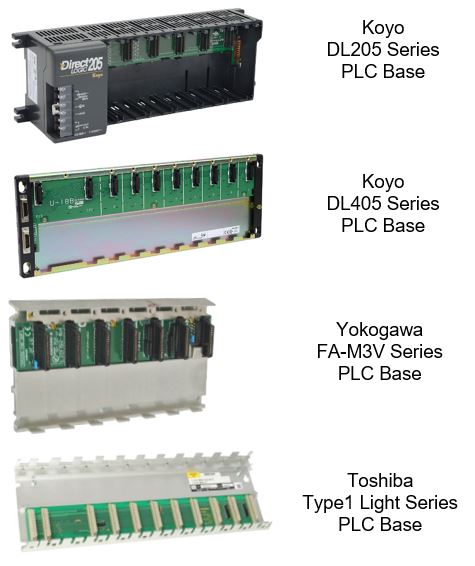
PLC Base
PLC Base

Hitachi uses the term PLC base rack for their EHV+ Series PLC mounting system. An example of a HitachiEHV+ Series PLC base rack is shown below….
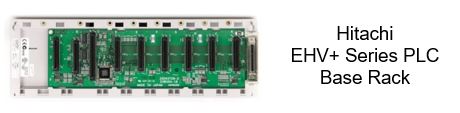
PLC Base Rack
PLC Base Rack

The term PLC Rack is commonly used to describe a group of PLC hardware components that have been installed into any given PLC mounting system. A PLC rack can also be referred to as a PLC Drop. If a PLC rack has only input and output modules installed (no Processor CPU) then the PLC rack is called an I/O Rack or a Remote I/O (RIO) Rack (usually located away from the main PLC rack).

Remember the term PLC drop and RIO drop can also be used when referring to PLC racks and RIO racks. A simple example of a PLC rack connected to multiple RIO racks is shown in the diagram below….
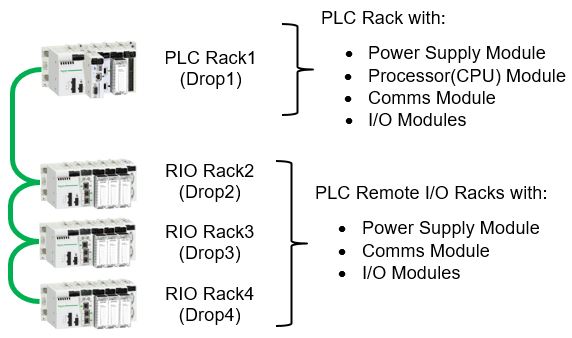
PLC Rack and Remote I/O (RIO) Rack

Rail Mounted PLC

The PLC mounting rail is commonly known as DIN rail. It is made out of metal and provides a means of mechanically securing the PLC hardware components. The PLC mounting rail is generally screwed into an enclosure pan and then the PLC hardware components are clipped or screwed in, side by side.

DIN rail is an industrial rail mounting system that was developed in Germany in the 1920s. It has become extremely popular and is now extensively used for mechanically mounting of a variety of electrical components such as terminal blocks, circuit breakers, power supplies, PLCs, relays, timers etc.

The 2 most common PLC mounting DIN rail types are:

  • 35mm DIN rail
  • Siemens Simatic DIN rail

PLC 35mm DIN Rail Mounting

The 35mm DIN rail has kind of a D shaped profile and comes in various pre-cut lengths, but can also be easily cut to size. It measures 35mm in width from the LHS edge to the RHS end. Most 35mm DIN rail comes with either center punch divot holes or slotted holes in the base to allow ease of installation with mounting screws into an electrical panel.
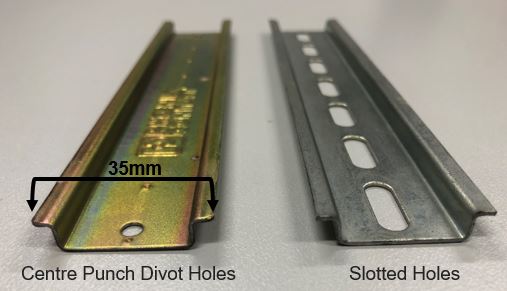
PLC 35mm DIN Rail Mounting System

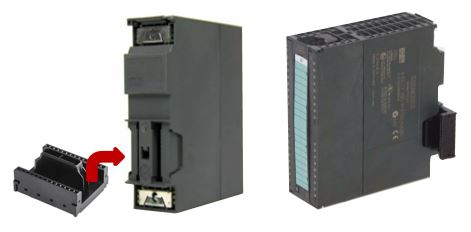
The PLC hardware components that can be mounted on DIN rail have been designed with a mounting arrangement on the back of the component. There is a hook like arrangement on the upper side and a clip type arrangement with release/engage slot on the lower side. The pictures below shows the basic PLC 35mm DIN rail mounting system.…
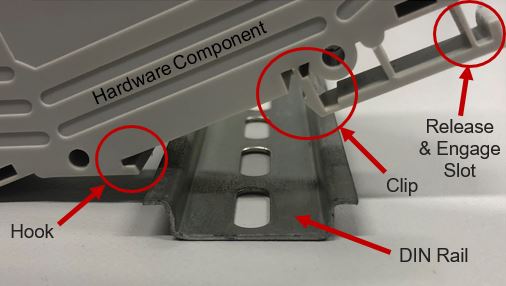
PLC 35mm DIN Rail Mounting System (Rail and Component-Hook & Clip)

DIN rail works by hooking the back of the electrical component into the upper part of the rail and then pushing it towards the DIN rail until the lower part clips in. The DIN rail release mechanism works by using a flat head screw driver to pull down on the spring loaded tab at the bottom rear of the electrical component while using an upward lifting motion to unhook it from the top part of the DIN rail.

To install a PLC hardware component onto DIN rail follow the steps below:

  1. Grab the PLC hardware component and hook it onto one side of the DIN rail.
  2. Lever the PLC hardware component down toward the DIN rail until it clicks in. If the component does not have a spring loaded clip, then the clip will need to be manually released (pulled out) and engaged (pushed in) with a flat head screw driver.
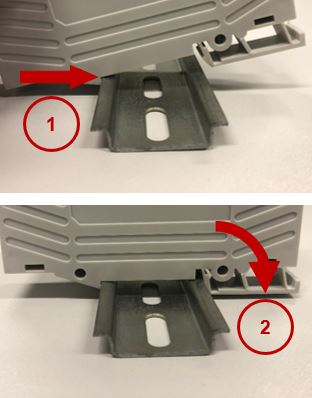
How does DIN rail work – Install a PLC Hardware Component

To remove a PLC hardware component from DIN rail follow the steps below:

  1. Grab a small/medium sized flat head screw driver and place it in the clip slot. Pull the clip out by applying a force on the screw driver in the opposite direction to the DIN rail. Usually you can lever the screw driver against the PLC hardware component case to make it easier.
  2. Hold tension on the clip using the screw driver as you lift the PLC hardware component up and out past the edge of the DIN rail. If the component does not have a spring loaded clip, then the clip is simply released (pulled out) with a flat head screw driver, there’s no need to hold tension while levering up and out.
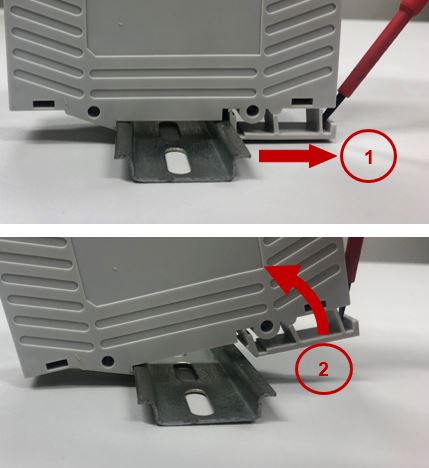
How does DIN rail work – Remove a PLC Hardware Component

Siemens Simatic PLC DIN Rail Mounting

The Siemens PLC DIN rail is only for use with the Siemens S7-300 PLC and the Siemens S7-1500 PLC. The Siemens S7-300 DIN rail and the Siemens S7-1500 DIN rail have a different profile so they cannot be interchanged. They both can be ordered in various predefined lengths 160mm, 245mm, 482mm, 530mm, 830mm and 2000mm.

Below is a picture of both the Siemens S7-300 DIN rail and the Siemens S7-1500 DIN rail…
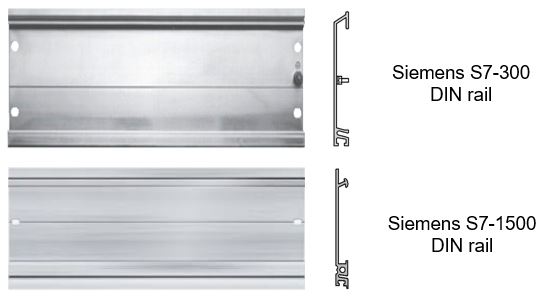
Siemens PLC S7-300 and S7-1500 DIN Rail

The Siemens PLC DIN rail works in a similar manner except it is screwed in at the bottom instead of clipped in.

Rail Mounted PLC Hardware Component Connection

The 3 most common methods that rail mounted PLCs use to connect their hardware components together on the mounting rail via the PLC bus is with:

  • Ribbon cable connectors
  • Plug and socket connectors
  • PLC bus couplers

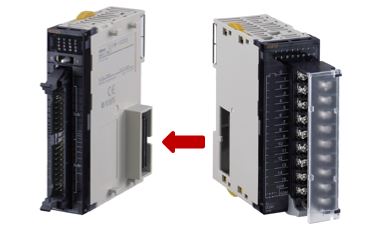
The type of PLC bus connection for rail mounted PLC will depend on the PLC Manufacturer. For Example Allen Bradley MicroLogix 1200 PLC uses a ribbon cable connectors, the Omron CJ1 Series PLC uses plug and socket connectors and the Siemens Simatic S7-300 PLC uses PLC bus couplers.
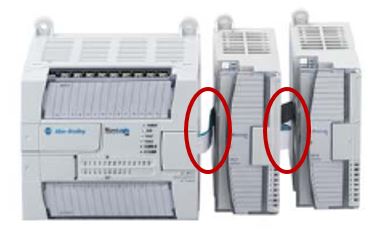
Allen Bradley MicroLogix 1200 PLC Bus Ribbon Cable Connector
OMRON CJ1 Series PLC Bus Plug and Socket Connector
Siemens S7-300 PLC Bus Coupler

Terminology Used to describe Rail Mounted PLCs

The terminology to describe a PLC with a mounting rail can vary depending on the manufacturer. Some examples that PLC manufacturers use to describe rail mounted PLCs include:

  • DIN rail PLC
  • Rack less PLC
  • Plugin PLC
  • Modular PLC
  • Expandable PLC
  • Stackable PLC
  • Snap In PLC
  • Side by Side PLC

Panel Mounted PLCs

A panel mounted PLC uses a mounting system that directly mounts the PLC and its hardware components without the additional need for a rack or rail. A panel mounted PLC will have mounting holes molded into the PLC housing and PLC modules, usually around the edges of the PLC housing.

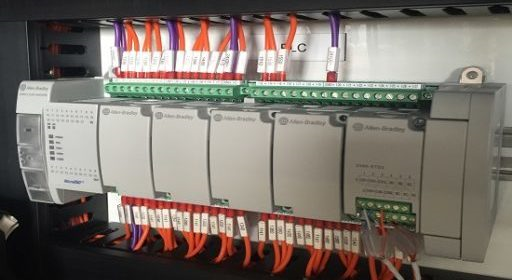
Fixed PLC types are usually designed to be panel mounted. But a lot of fixed PLCs combine panel mounting holes and a DIN rail mounting facility as well. Also, Modular PLCs that are DIN rail mounted sometimes have combined DIN rail mounting and panel mounting holes. The Allen Bradley ControLogix 1200 is a panel mounted PLC, but also has the facility to be DIN rail mounted. See the picture below….
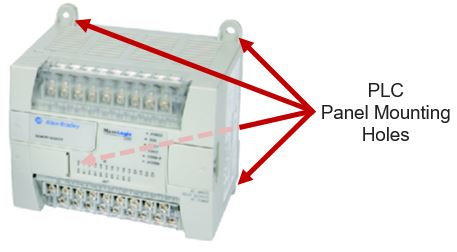
Panel Mounted PLC
Panel Mounted PLC

To install a panel mounted PLC onto the pan of an electrical enclosure you need to:

  1. Mark where the mounting holes need to be on the enclosure pan using a template provided in the installation manual or the PLC itself.
  2. Drill and tap the enclosure pan mounting holes.
  3. Place the bolts (with washers) through the mounting holes provided on the PLC housing then screw and tighten the bolts into the enclosure pan.

Some people prefer installing panel mounted PLCs using self-tapping screws because it’s quicker.  BE CAREFUL here because some industrial sites have electrical installation standards that do not allow mounting of electrical equipment with self-tapping screws.

3. PLC Power Supply

The main purpose of a PLC power supply is to convert the available power supply voltage into a voltage that is usable by the PLC processor (CPU) and other PLC modules. The most common PLC power supply input voltages are 120VAC, 240VAC, AC voltage range (like 85-265VAC) and 24VDC. While the most common PLC power supply outputs are 24DC and 5VDC.

There are 3 main types of PLC power supplies:

  • Integrated PLC power supply
  • PLC power supply module
  • Remote PLC power supply

An Integrated PLC power supply is embedded in the PLC processor. Fixed type PLCs and some modular type PLCs have their PLC power supply embedded in the PLC processor. A PLC power supply module is separate to the PLC processor but is mounted on the same PLC rack as the PLC processor. While a remote PLC power supply is mounted away from the PLC rack and hard wire connected to the PLC processor.

PLC Power Supply Mounting

Most PLC manufacturers mount their PLC power supply modules at the LHS end of the rack. But some can be mounted on the RHS end or in the middle of the rack. Some PLC power supply mounting examples are below:

The Allen Bradley ControlLogix PLC Power Supply is mounted at the left end of the PLC rack….
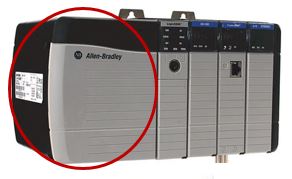
Allen Bradley ControlLogix PLC Power Supply

The Koyo DirectLOGIC 305 PLC Power Supply is mounted at the right end of the PLC rack….
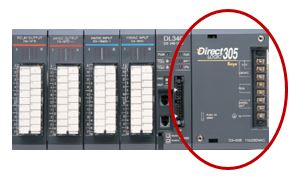
Koyo DirectLOGIC 305 PLC Power Supply

The Siemens Simatic S7-1200 Power Supply is integrated into the CPU Module….
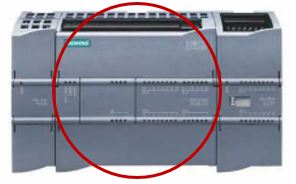
Siemens Simatic S7-1200 Power Supply

PLC Power Supply Connection

The output of the PLC power supply is usually seamlessly connected to the PLC processor (CPU) and other PLC modules by plugging directly into the PLC backplane bus. For example the Mitsubishi Melsec with Q61P PLC power supply has 100-240VAC input voltage and 5VAC output voltage via the PLC backplane bus to the CPU and other modules. See the diagram below….
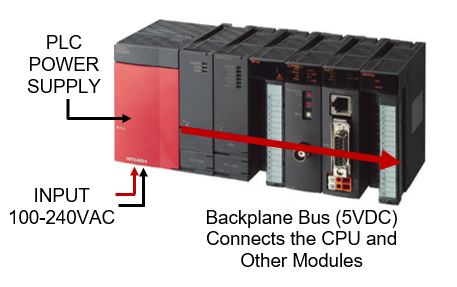
PLC Power Supply - Mitsubishi Melsec Q61P
PLC Power Supply – Mitsubishi Melsec Q61P

Some PLC power supplies require hard wire connection from the PLC power supply to the PLC processor and other PLC modules. Sometimes auxiliary 24VDC output terminals are provided on the PLC power supply for use with field instrumentation. If the PLC power supply does not have auxiliary 24VDC output terminals then a separate 24VDC power supply is required for use with field instrumentation.

The Siemens S7 300 PLC power supply has 120/240VAC selectable input voltage and requires a 24VDC hardwire connection to the PLC Processor (CPU). But the connection from the PLC CPU to other PLC modules is done via the PLC backplane bus. Also Siemens S7-300 PLC power supply has auxiliary 24VDC terminals that can be used for field instrumentation. See the diagram below….
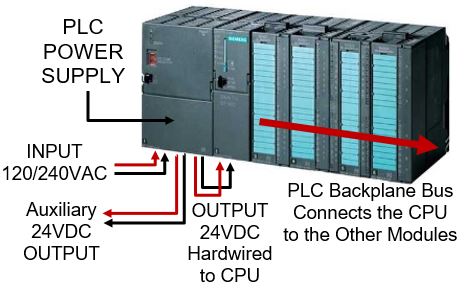
PLC Power Supply - Siemens S7-300
PLC Power Supply – Siemens S7-300

PLC Power Supply Size

The PLC power supply size will depend upon the overall size of the PLC system. It’s important to select the correct size of PLC power supply to maintain a stable PLC system. The more input and output modules that are mounted on the PLC rack, the larger the PLC power supply size will need to be.

It is common to specify the PLC power supply size in power (W) or apparent power (VA). If the PLC power supply input is AC then the size will be in power (W) or apparent power (VA). If the PLC power supply input is DC then the size will be in power (W). The PLC power supply output is always DC, so the size will also be expressed in power (W).

The PLC power supply input size is useful for determining the power feed requirement and protection for the PLC power supply module. But the PLC power supply rating data is what is needed to accurately select the correct PLC power supply.

PLC Power Supply Rating

The PLC power supply rating is generally specified in Voltage (V) and Current (A). In actual fact, it’s the output PLC power supply rating that is required when choosing a PLC power supply because the total current load of the combined modules on the PLC rack must not be greater than the PLC power supply rated output current.

Another important factor that affects the PLC power supply rating is the ambient temperature rating. If the ambient temperature is kept within the specified limits then the PLC power supply will perform as specified. Otherwise it will need to be de-rated to avoid overheating. To de-rate the PLC power supply simply means that the load on the PLC power supply is reduced in order to decrease the output current draw.

The Allen Bradley ControlLogix 1756-PA50 data sheet has an example of PLC power supply de-rating for increased ambient temperatures. It states that the output current rating for 24VDC at 50 DegC is 2.5A and at 60 DegC it reduces to 2.0A. If there is a situation where the ambient temperature exceeds the maximum ambient temperature rating specified, then extra cooling to the PLC cabinet will be required.

The various PLC manufacturers all have different PLC power supply sizes and they pick and choose what ratings and specifications they include on their PLC power supply labels. If there is some information not contained on the label it may be located in the PLC manufacturers’ data sheets. Having said that, all PLC manufacturers will specify the PLC power supply output voltage and current ratings.

Some examples of PLC power supplies and their output ratings are shown below:

  • Mitsubishi Melsec Q61P PLC power supply, 5VDC 6A
  • Schneider Quantum PLC Power Supply 140CPS11400, 5.1VDC 8A
  • Siemens S7 300 PLC PLC Power Supply PS-307, 24VDC 5A
  • Allen Bradley ControlLogix PLC Power Supply 1756-PA72, with multiple backplane voltages-(1.2VDC 1.5A) (3.3VDC 4A) (24VDC 2.8A) (5.1VDC 10A)

Check out some examples of different PLC power supply labels….
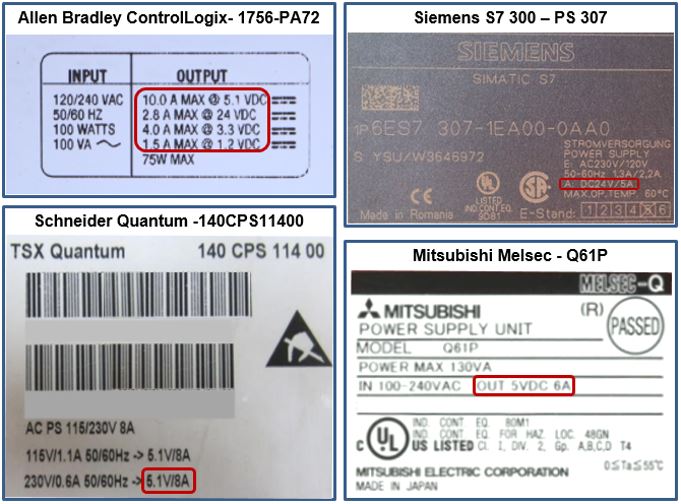
PLC Power Supply Rating Labels

Below is a PLC Power Supply Rating Table comparing the label specifications shown above.…

ManufacturerAllen BradleyMitsubishiSchneiderSiemens
BrandControlLogixMelsecModicon QuantumSimatic
PLC Power Supply1756-PA72Q61P140CPS11400S7-300
Power Input100W/100VA~130VANot ShownNot Shown
Frequency Input50/60HzNot Shown50/60Hz50-60Hz
Voltage Input85-265VAC100-240VAC115/230VAC120/230VAC
Current InputNot ShownNot Shown1.1A(115VAC)
0.6A(230VAC)
2.3A(120VAC)
1.2A(230VAC)
Power Output75W MaxNot ShownNot Shown138W Max
Voltage Output (DC)1.2V, 3.3V, 24V, 5.1V5V5.1V24V
Current Output (DC)1.5A(1.2VDC)
4A(3.3VDC)
2.8 (24VDC)
10V(5.1VDC)
6A8A5A
Operating TemperatureNot Shown0-55 DegCNot ShownMax 60 DegC
PLC Power Supply Comparison Table

4. PLC Input and Output Hardware Interface

In an industrial PLC system the PLC input and output modules are a common interface between the field devices and the PLC processor (CPU). The PLC inputs and outputs are generally connected to the field devices via a terminal strip. Communication modules with fieldbus protocols like Ethernet IP, Profinet etc. can also be used as a PLC input and output interface.

In a PC (Personal Computer) the input and output interface is the connection between the peripheral devices and the PC. The keyboard and mouse are examples of input devices and the USB port is an example of the input interface. The monitor is an example of an output device and the monitor port is an example of the output interface.

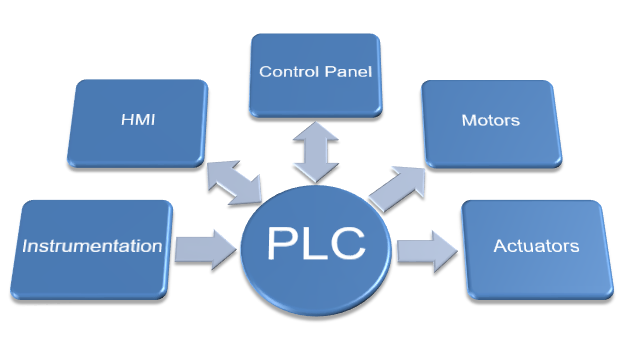
In a PLC, the inputs are connected to PLC input devices like pushbuttons, limit switches, proximity sensors, temperature transmitters, pressure transmitters, level transmitters, encoders etc. And the PLC outputs are connected to PLC output devices such as relays, motor contactors, VFDs (Variable Frequency Drives), solenoid valves, proportional vales, indication lights, sirens etc.

See the PLC Inputs and Outputs block diagram below…
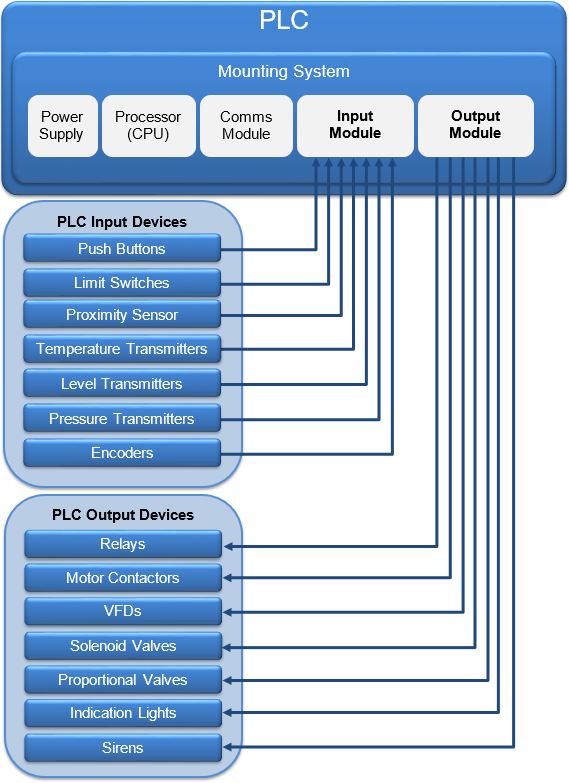
PLC Inputs and Outputs

Types of PLC Input and Outputs

The 2 main types of PLC input and output signals are analog and digital (discrete). Analog and digital inputs both measure external field conditions and report it back to the PLC processor (CPU). And analog and digital outputs both send command signals from the PLC processor (CPU) in order to activate field devices. So what’s the difference?

The main difference between PLC analogue I/O and digital I/O are:

  • Signal Format
  • Signal Wiring
  • Signal Processing

The signal format is the main difference between PLC analogue and digital signals. Analog input and output signals are a variable value which change between a specific value-range. Whereas digital input and output signals follows the binary principle and are either ON or OFF.

PLC analog inputs (AI) and analog outputs (AO) are signals that are variable in nature. They measure or output a variable signal that lies between a specific value-range. The most common signal types are 0-10V and 4-20mA. Some examples of analogue inputs are temperature sensors, pressure sensors, weight meters and flow meters. While examples of analogue outputs are motor speed control, proportional solenoid valves.

Digital inputs (DI) and digital outputs (DO) are wired normally open (NO) or normally closed (NC). They are either ON or OFF. Some examples of digital inputs are limit switches, push buttons, proximity sensors, temperature switches. While examples of digital outputs are motor start relays and solenoid valves.

PLC analog and digital signal wiring is also different because of the inherent difference in signal format. In most cases analog I/O also requires a screened cable to suppress signal interference from external electromagnetic sources. 

PLC analog and digital signal processing in the PLC CPU is also different. Analog I/O requires at least 1 word (16 bits) of data per I/O point while digital I/O only requires 1 bit of data per I/O point.

PLC Input and Output Modules

PLC inputs and outputs can be embedded in the PLC processor (CPU) or come as an input and/or output module. When PLC inputs and outputs are embedded in the PLC processor they cannot be changed. But when PLC input and output modules are used they can be combined to form a custom arrangement of PLC inputs and outputs.

PLC inputs and outputs that are embedded in the PLC processor (CPU) are usually associated with fixed type PLCs. Whereas, PLC input and output modules are usually associated with modular and distributed type PLCs. Some PLCs have a combination of embedded inputs and outputs in the PLC processor and input and output modules to allow expansion.

An example of a PLC with embedded inputs and outputs that are onboard the PLC processor is the Allen Bradley MicroLogix 1200. The inputs and outputs onboard the processor are fixed and cannot be changed. However, the Allen Bradley MicroLogix 1200 does also have optional PLC input and output modules available for expansion.
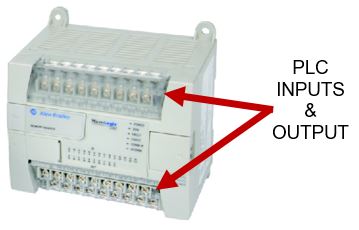
PLC Inputs and Outputs Embedded in the CPU

The Delta AS series PLC is an example of a modular PLC with PLC input and output modules that can be arranged to provide a custom arrangement of inputs and outputs.
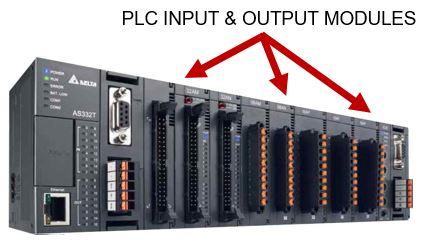
PLC Input and Output Modules

The most common PLC input and output modules are Digital Inputs (DI), Analog Inputs (AI), Digital Outputs (DO), Analog Outputs (AI), Thermocouple Inputs, Resistive Temperature Detector (RTD) Inputs, Load Cell Inputs and Encoder, High Speed Counter and Positioning Inputs and Outputs.

What is the function of the PLC Input and Output Modules?

PLC input and output modules are usually called PLC I/O modules (or PLC I/O cards), for short. They can be a dedicated input module, a dedicated output module or a module with a combination of both inputs and outputs. PLC input and output modules are mounted alongside the PLC processor (CPU) and can be selected and arranged according to application requirements, making them inherently flexible.

The main function of PLC input modules is to condition the input signals received from the field devices into a format that the PLC processor accepts. The main function of PLC output modules is to condition the output signals sent from the PLC processor into a format that the field devices accept.

Along with conditioning the input and output signals to and from the PLC processor, the PLC I/O modules also provide electrical isolation between the I/O modules internal electronic components and its terminal connections. Electrical isolation is necessary to protect the PLC I/O modules internal electronic components and is usually done optically with optocouplers, sometimes called optoisolators. 

PLC Input and Output Hardware Connection

There are various PLC input and output connection methods. Some connection methods are more tedious than others. In general connection of field devices to PLC inputs and outputs is a labor intensive exercise, especially when there are large volumes of PLC I/O.   

The most common PLC input and output hardware connection methods are:

  • Hardwire connection with terminals
  • Fieldbus network connection

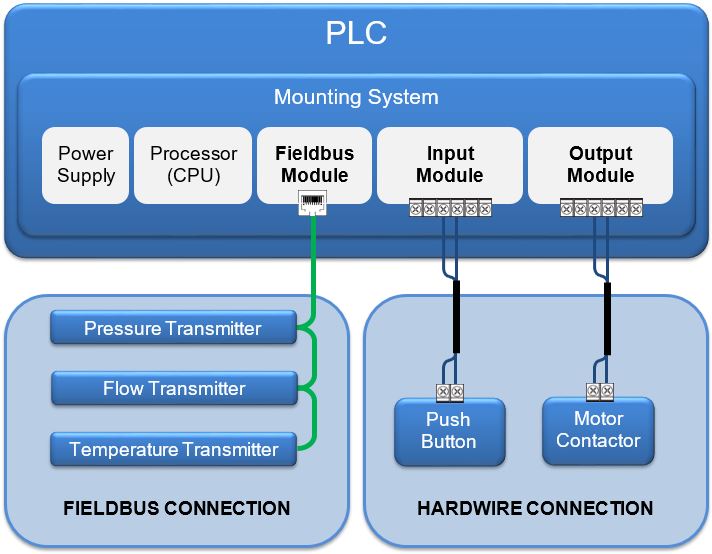
The diagram below shows PLC input and output connections using both the hardwire connection and fieldbus network connection methods….
PLC Input and Output Connection

Hardwire connection of PLC inputs and outputs involves running multi-core cables from the PLC input and output modules to the field devices and connecting the wires at both ends, usually with screw terminals.

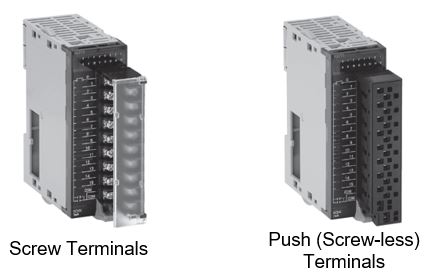
Some PLC manufacturers have plug in terminal options for their PLC input and output hardwire connection. Plug in terminal options other than screw terminals are designed to speed up PLC I/O wiring installation time. The main plug in terminal options for PLC I/O connection are:

  • Screw terminals
  • Push (Clamp) screw-less terminals
  • Wiring looms
  • Wiring Modules

An example of a PLC that has a removable terminal strip with screw terminal block and screw-less clamp terminal block options is the Omron CJ1 Series PLC, see below….
PLC Input and Output Terminal Block Connection Options

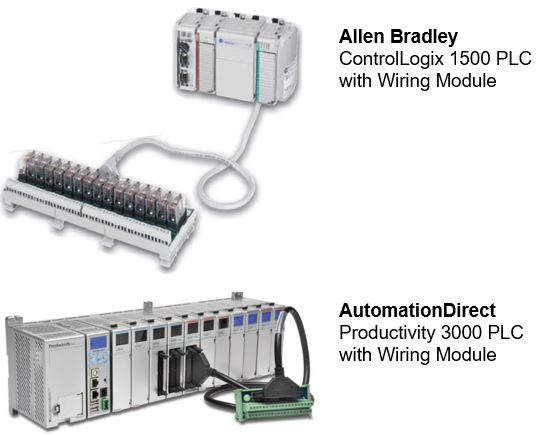
Prefabricated PLC I/O wiring looms or wiring modules are designed to make hardwire connection even easier and less time consuming for installers. For example the Allen Bradley MicroLogix 1500 and the AutomationDirect Productivity 3000 PLCs both have wiring modules with prefabricated cables that plug into the PLC I/O modules instead of having to wire each PLC I/O point individually, see below….
PLC Input and Output Wiring Module Connection

Fieldbus network connection of PLC input and output devices involves a network connection such as Ethernet I/P, Profinet, etc. Connection of PLC input and output devices using the fieldbus network requires a fieldbus module, unless the fieldbus network port is embedded in the processor module.

The latest Ethernet based fieldbus networks such as Profinet, Ethernet IP, Ethercat, Modbus TCP/IP, etc. can be daisy chained if the field devices have an Ethernet switch built in. Otherwise complex networks can established using external Ethernet switches. Older 2 wire fieldbus networks such as Profibus, DeviceNet, Modbus RTU, etc. can be daisy chained with complex networks established using repeater and splitter devices.    

5. PLC Communication Hardware Interface

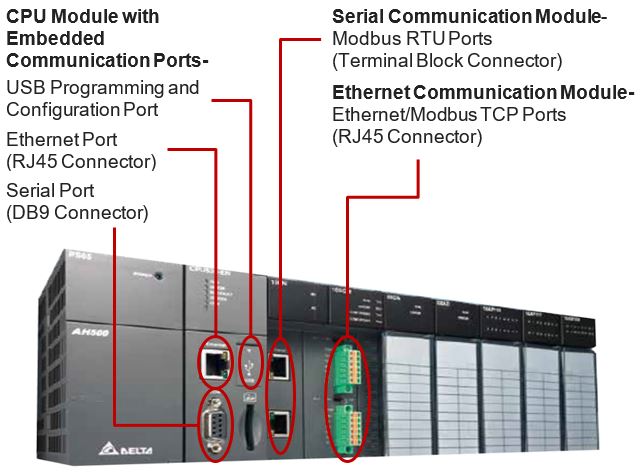
PLCs can communicate to multiple devices by using a communication interface. The communication interface has communication ports which allows cable connection to devices such as other PLCs, remote I/O drops, fieldbus devices, touch screens, programming PCs and servers. Multiple communication interfaces may be required for larger and more complex applications.

The PLC communication interface can exist as either embedded communication ports on the PLC processor or as communication modules. If there is a need for multiple communication interfaces then it’s quite common to see both embedded communication ports on the PLC processor and extra communication modules slotted into the rack. 

PLC communication ports commonly use either a Serial based communication protocols or Ethernet based communication protocols. Serial communication ports on a PLC usually use D-sub connectors or terminal connectors, while Ethernet communication ports usually use RJ45 connectors.
PLC Communication Ports

Some popular Ethernet based protocols used for PLC communication include Ethernet IP, Profinet, Ethercat, Modbus TCP/IP and BACnet IP. With Serial communication ports, some of the common protocols are DeviceNet, Profibus DP, Modbus RTU, CANopen, BACnet MS/TP, MPI, DirectNet, RS-485, RS-422 and RS-232.

PLC communication ports that have serial protocols are now considered “old school” by some. However, they are readily available, generally cheaper and are still useful in certain applications. However they are generally slower and cannot handle the same data bandwidth as modern day industrial Ethernet based protocols.

6. PLC Programming Device

The last, but by no means the least, is the PLC programming device. Programmable Logic Controllers need to be programmed somehow. There are 2 devices that can do it.

The two most common PLC programming devices are handheld programming devices and personal computers (PC). Both are used to develop the PLC program (like ladder logic) and then transfer it into the PLC memory. The PLC programming devices connect to the PLC using a cable and transfer the PLC program using either an Ethernet or Serial based communication protocol.

Handheld programming devices are propose built to develop PLC program. But they have limited programming memory, have a very basic display, simple keyboard input functions and are slow and tedious to use. They are generally limited to programming small applications with low numbers of I/O.  

Examples of PLC hand held programmers (HHP) from Mitsubishi, Allen Bradley and Omron are shown below….
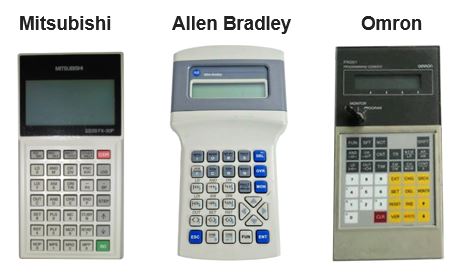
PLC Handheld Programmer (HHP)

PC programming devices enables use of large amounts of programming memory (Hard Drive or Solid State Drive) and has a monitor, keyboard and mouse allowing easy and fast programming.  The PLC program is developed using the PLC manufacturers programming software application that is installed onto the PC operating system (like Windows). It allows quick and easy programming of complex applications with large amounts of I/O. In fact, nowadays, you’ll find most PLCs are programmed with a PC.

If you are interested in learning the basics of a PLC (Programmable Logic Controller) click here.
PLC Architecture and Types: With Comparison Table


In this article we’ll look at basic PLC architecture, the different types of PLCs used in industrial automation, advantages and disadvantages of PLC types and compare them in a handy reference table.

What Is PLC Architecture?

The term PLC architecture refers to the design specification of the various PLC hardware and software components and the how they interact with one another to form the overall PLC system. The architecture of a PLC is based on the same principles of that used in standard computer architecture. However, PLC architecture does differ because the design is based around providing high reliability, immunity to harsh industrial environment, ease of maintenance and access to large amounts of peripheral inputs and outputs.

If a PLC system is described as having closed architecture it refers to a proprietary system of hardware and software components that cannot (or is difficult to) connect to other manufacturers components and software. However if a PLC system is described as having open architecture it refers to the PLC system as having off the shelf components that adhere to a common standard and are easily connected to other manufacturer’s hardware and software components. 

The Basics of How PLC Architecture Works

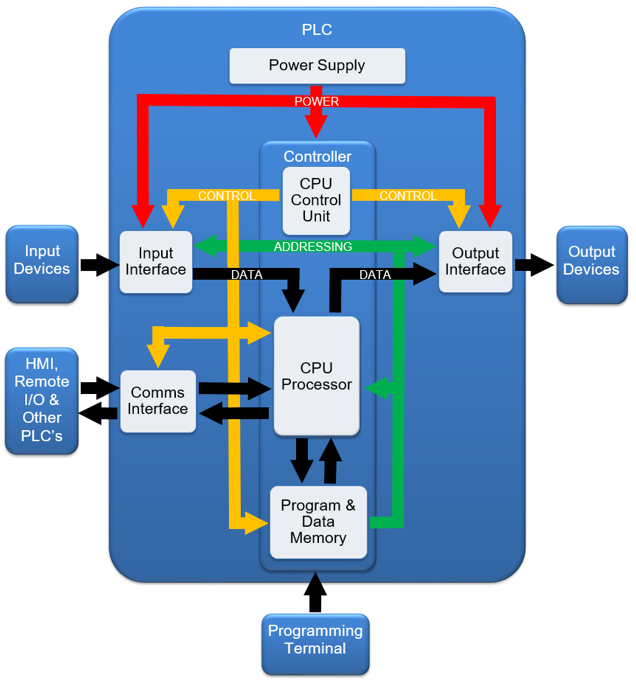
The heart of the PLC system is the CPU (Central Processing Unit). It is made up of a control unit and processor. The CPU control unit manages the interaction between the various PLC hardware components while the CPU processor handles all the number crunching and program (eg ladder logic) execution.

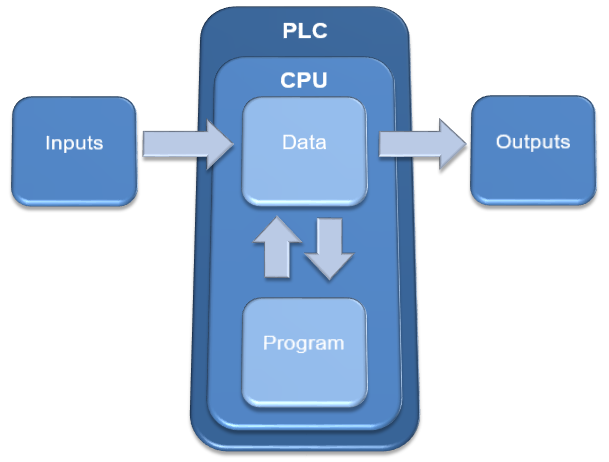
The block diagram below explains the basic architecture of a PLC….

PLC Architecture Block Diagram

Data flow is from the input devices, through the CPU processor and then to the output devices. The CPU processor also exchanges data with the program and data memory. Once all the data is gathered the program (eg ladder logic) is processed in a cyclic fashion. The resulting data flows to the output interface for conditioning and execution of the output devices.

The CPU also controls and exchanges data with the communication interface and devices.

An addressing system is used for data organization that is shared between the various hardware components.

A programming terminal is used to formulate the PLC program (eg ladder logic), load the program into the controller and monitor/control the PLC and its program.

The power supply is responsible for supplying and managing the power requirements of the various PLC hardware components.

Types of PLC Architecture

PLC architecture has advanced tremendously since its inception of the PLC back in the 1960s. Today the options and variations available to the traditional PLC architecture types is almost endless between different PLC manufacturers.

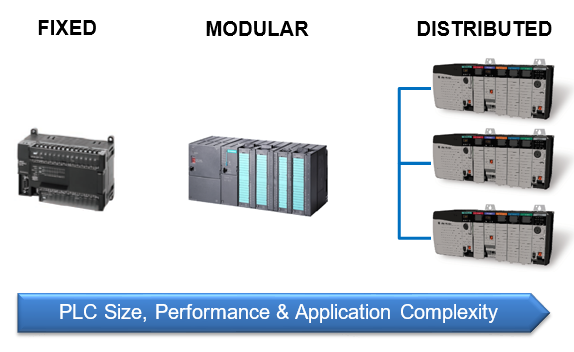
The 3 distinct types of PLC architecture available for use in industrial automation are known as fixed, modular and distributed. The terminology surrounding PLC types can vary between PLC manufacturers, especially when talking about fixed PLCs. There is also crossover between PLC types with some fixed type PLCs having modular type features and some modular type PLCs having distributed type features.

When considering PLC architecture types we can generally say that fixed PLCs are used for smaller sized, less complex application. Modular PLCs are generally used for medium sized, more complex applications. Whereas distributed PLCs are used for large sized, extensive application spread across multiple location.

Fixed, Modular and Distributed PLC Types

Let’s take a look at the 3 types of PLCs in more detail….

Fixed PLC Type Architecture

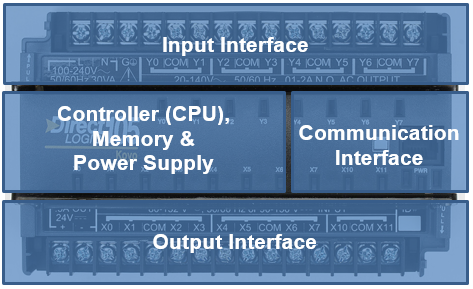
A fixed PLC employs single unit architecture where all the hardware components are embedded into a single unit. Hardware components such as the power supply, CPU, memory, input, output and communication interfaces are all are built into a fixed PLC. The most common names given to fixed PLCs by different manufacturers are fixed, integrated, nano, micro, compact, small, mini, basic, unitary, standard and brick.

Diagram of Fixed Type PLC Architecture

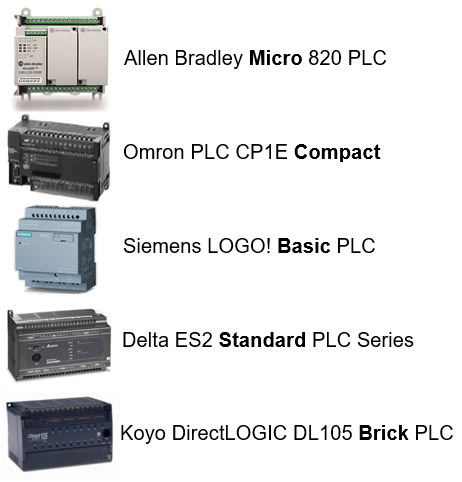
Some examples of fixed PLC types by different manufacturers and the terminology they use is shown below:

  • Allen Bradley PLC – Micro
  • Omron PLC – Compact
  • Siemens PLC – Basic
  • Delta PLC – Standard
  • Koyo PLC – Brick
Examples of Fixed PLC Types

Regardless of the different terminology that PLC manufacturers use to identify the type, size and performance level of their PLCs, a fixed PLC is universally characterized by:

  1. PLC naming convention – Fixed, integrated, nano, micro, compact, small, mini, basic, unitary, standard and brick.
  2. CPU processor – Low powered.
  3. Program and data memory size – Small.
  4. Power supply – Embedded.
  5. Input Interface – Embedded.
  6. Output Interface – Embedded.
  7. Communication interface – Embedded.
  8. Mounting system – Single unit.
  9. Physical size – Small.
  10. Flexibility – Input, output and communication interfaces are fixed.
  11. Expandable – No
  12. Customizable – No
  13. Applications – Basic applications with small number of inputs and outputs.
  14. Cost – Low $$$$$.

Advantages of Fixed PLCs

Fixed PLCs have some great advantages over other types of PLCs. They have been specifically design to cater for smaller, low end automation projects. The advantages of a fixed PLC are:

  • Small in size so they do not take up very much space in an enclosure.
  • Quick and easy to mount.
  • Low in cost so they are an economical solution for basic applications.

Disadvantages of Fixed PLCs

If you’re considering selecting a fixed PLC to automate your next application its prudent to also consider some of disadvantages to make sure you are selecting the type of PLC that is appropriate for your application. The disadvantages of a fixed PLC are:

  • CPU processing power is low and memory is small so complex tasks can be difficult to realize.
  • Inflexible because the number of input, output and communication interfaces are fixed.
  • Only suitable for basic applications with small number of inputs and outputs.

The Modern Day Fixed PLCs

The majority of modern day fixed PLCs are far from what the traditional definition of a fixed PLC is. Technology advancements and demand from industry has driven them away from being a simple, low powered unit with fixed amount of input, output and communication interfaces.

The modern day fixed PLC is feature packed with a large range of options such as powerful CPU’s, expandable modules and network capabilities that are bordering and even overlapping into modular and distributed PLC architecture. This has resulted in the fixed PLC expanding its reach into a larger range of industrial automation applications.

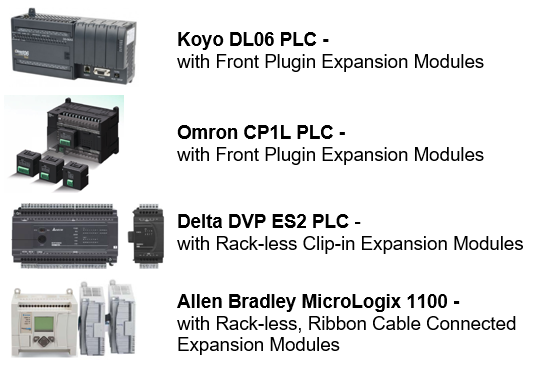
For example the Omron Sysmac CP1L and Koyo DL06 PLCs have traditional fixed PLC architecture but at the same time are expandable with built in slots to allow for extra plugin modules. Another example of a modern day fixed PLC that incorporates modular PLC design is the Delta DVP ES2 with a rack-less design and clip-in expansion I/O modules. The Allen Bradley MicroLogix 1100 PLC range also has the ability to further extend using I/O expansion modules to the side of the PLC using ribbon cable…..

Examples of Fixed PLCs with Expansion Modules

Modular PLC Type Architecture

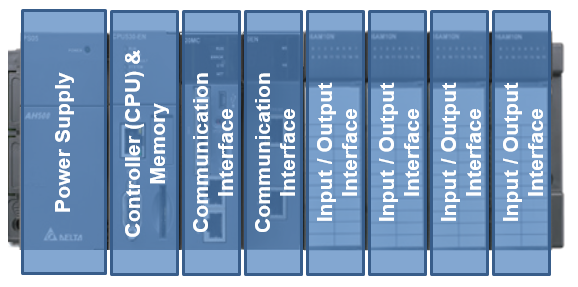
A modular PLC has a separate module for each of its hardware components. Each PLC module is interconnected using a common mounting system. The mounting system has a certain amount of modules that it can accommodate. This means a modular PLC can be configured to be application specific.

Diagram of Modular Type PLC Architecture

A PLC module is a hardware component that carries out a specific function in accordance to the architecture of the PLC system. The main modules used in a modular type PLC are the processor module, power supply module, input modules, output modules and communication modules. The design of these modules will vary for different manufacturers and usually cannot be interchanged between PLC manufacturers.

Modular PLCs are used for automating industrial applications where a higher powered processor and large numbers of input and output devices are required. These types of applications that use modular PLCs are usually associated with a higher level of complexity with regards to operation, process control and monitoring. Some examples of industries that readily use modular PLCs are manufacturing, food and beverage, mining and logistics.    

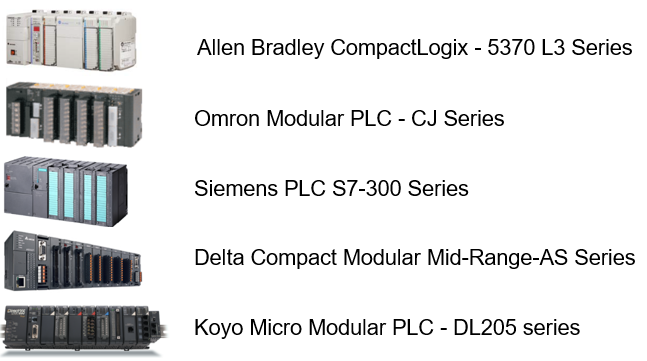
Some examples of modular PLC types by different manufacturers are shown below:

Examples of Modular PLC Types

A modular plc is characterized by:

  1. PLC naming convention – Modular.
  2. CPU processor – Medium to High powered.
  3. Program and data memory size – Medium to Large.
  4. Power supply – Module.
  5. Input Interface – Input Module.
  6. Output Interface – Output Modules.
  7. Communication interfaces – Communication Modules.
  8. Mounting system – Rack, backplane, rail or chassis.
  9. Physical size – Medium to Large.
  10. Flexibility – High
  11. Expandable – Yes
  12. Customizable – Yes
  13. Applications – Medium to High end applications with large number of inputs and outputs.
  14. Cost – Medium to high $$$$$.

What are the Advantages of Using a Modular PLC Instead of a Fixed PLC?

Modular PLCs have some great advantages over other fixed PLCs. They have been specifically design to cater for medium to high end automation projects.

The advantages of using a modular PLC instead of a fixed PLC are that modular PLCs have larger memory, higher performance processors, larger number of input and outputs, increased communication options, are fully customizable and are easily expanded. This enables the modular PLC to handle larger scale applications and of higher complexity compared to a fixed PLC.

Modular PLCs also have the ability to have remotely mounted input and output modules (distributed I/O) that are interconnected using a communication link. This allows for increase number of inputs and outputs, reduced cable requirements and installation flexibility.

The modular PLC also has maintenance advantages over fixed PLCs. Each hardware component is separate housed in a module which can be replaced if it is faulty. Whereas a fixed PLC has all its component embedded into a single unit. So when there is a fault the whole unit must be replaced in its entirety and the faulty unit ends up in the trash.  

Disadvantages of Modular PLCs

If you’re considering selecting a modular PLC to automate your next application it’s wise to also consider some of disadvantages to make sure you are selecting the most suitable PLC for your application. The disadvantages of modular PLC are:

  • Large in size so they take up more space in an enclosure than a fixed PLC.
  • The mounting system is more complex than a fixed PLC.
  • Higher in cost than a fixed PLC so may not be cost effective for smaller applications.

Distributed PLC Type Architecture

A distributed PLC is a high end PLC system with modular architecture and the capability to interconnect hardware components across different locations via high speed communication links. Each location in the distributed PLC system contains multiple hardware modules that are housed in a mounting system and are usually called a node, rack or drop.

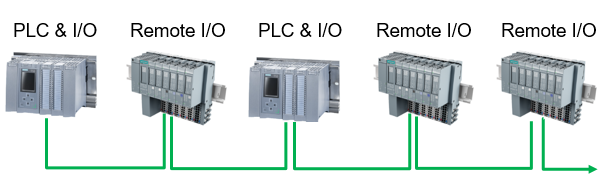
Each drop, node or rack in the Distributed PLC system must have a communication module and can either contain a PLC processor module with input and output (I/O) modules or just I/O modules. When there is a communication module with no PLC processor module and just I/O modules then the node is called distributed I/O or remote I/O.

Architecture of a Distributed PLC Type

Distributed PLCs are used for large factories and large processing facilities because they are not limited to physical location. They allow hardware components to be located in different locations by utilizing high speed communication links to interconnect processors and distributed I/O. The distributed PLC type is considered to be a site wide process control solution.

The biggest differences between distributed PLCs and other types of PLCs is that they contain high performance processors, large memories and are able to handle large volumes of I/O, use higher level programming languages and can handle large amounts of complex process control tasks. 

In the past a Distributed Control Systems (DCS) was used for large process plants. But the technology driven PLCs of today are performance packed and can handle the heavy demands of a distributed control system.

Examples of Distributed PLC Types

In today’s world of advanced PLCs most modular PLCs have the features of a distributed PLC. Regardless of the terminology used a distributed PLC is universally characterized by:

  1. PLC naming convention – Distributed or Modular with Remote I/O.
  2. CPU processor – High powered.
  3. Program and data memory size – Large.
  4. Power supply – Module.
  5. Input Interface – Input Modules.
  6. Output Interface – Output Modules.
  7. Communication interfaces – Communication Modules.
  8. Mounting system – Rack, backplane, rail or chassis.
  9. Physical size – Medium to Large.
  10. Flexibility – High
  11. Expandable – Yes
  12. Customizable – Yes
  13. Applications –High end applications with large number of inputs and outputs.
  14. Cost –High $$$$$.

What are the Advantages of Using a Distributed PLC?

Distributed PLCs have been designed to process and handle large amounts of data and complex process control. As such they have the following advantages over other PLC types….

  • Plant wide control network with multiple processors and remote I/O drops.
  • High performance processor.
  • Large program and data memory.
  • Able to handle large volumes of I/O.
  • Can handle large amounts of complex process control tasks. 
  • Ease of maintenance.
  • Save time and money on installation costs.

Disadvantages of Distributed PLCs

Because of the high end features that a distributed PLC has they come with some disadvantages that must be considered when selecting the type of PLC that is required for your automation system….

  • Large in size with bigger installation footprint.
  • The mounting system is more complex than a fixed PLC.
  • Higher in cost than other types of PLC so they may not be cost effective for smaller less complex applications.
  • Higher level programming skills may be required.

PLC Types Comparison Table

PLC TYPES FIXED PLCFixed PLCMODULAR PLCModular PLCDISTRIBUTED PLCDistributed PLC
CPU PerformanceLowMedium to HighHigh
Program & Data Memory SizeSmallMedium to LargeLarge
Power SupplyEmbeddedModuleModule
Input InterfaceEmbeddedModulesModules
Output InterfaceEmbeddedModulesModules
Communication InterfaceEmbeddedModulesModules
Mounting SystemSingle UnitRack, Back plane, Rail or Chassis.Rack, Back plane, Rail or Chassis.
Physical SizeSmallMedium to LargeMedium to Large
FlexibilityNoYesYes
CustomizableNoYesYes
ApplicationsBasic applications with small number of inputs and outputs.Medium to high end applications with large number of inputs and outputs.High end applications and plant wide control with a very large number of inputs and outputs.
CostLow $$$$$.Medium $$$$$.High $$$$$.

In the next section we’ll learn about PLC hardware and the essential components that make up a PLC system.

To got to the next section please click here.

PLC Manufacturers: The Latest PLC Brands, Rankings & Revenues


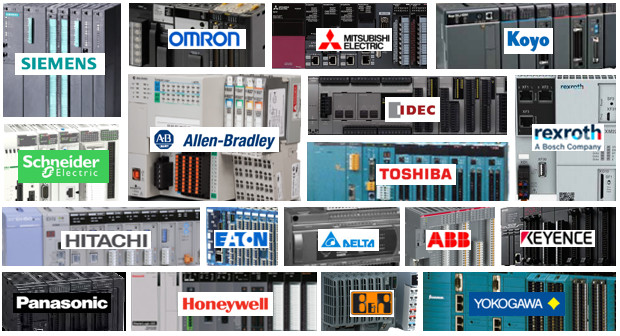
Today competition in the industrial automation industry is fierce with companies being driven to become PLC manufactures and develop their own PLC brands in order to keep up and stay in front of the technology curve.

All the big industrial automation brands are now manufacturing their own PLCs. Some of the major PLC manufacturers have diversified to become large conglomerate corporations include brand names like Siemens, Mitsubishi Electric, ABB, Schneider Electric, Hitachi, Panasonic and Fuji Electric. Other brand names have remained solely focused on manufacture of PLCs and other industrial automation equipment like Rockwell Automation, Omron, Keyence, Unitronics, Fatek, Idec and Yokagawa.

As the industrial automation landscape changes some PLC manufacturers have come and gone while others have merged to stay competitive. Some companies have added a PLC brand in the market to their portfolio of products via company acquisition or takeover. PLC manufacturers such as General Electric (GE Fanuc), Telemecanique, Square-D and Cutler-Hammer where leading PLC providers in their hay day but are no longer being developed or manufactured and have made way for the next generation of PLCs to enter the market.

Below is an up to date list of 35 of the best PLC manufacturers in the world for 2020 in alphabetic order….

List of PLC Manufactures for 2020

  • ABB (B&R Automation)
  • Beckhoff
  • Bosch (Rexroth)
  • Controllino
  • Delta Electronics
  • Eaton (Cutler-Hammer)
  • Emerson (General Electric)
  • Entertron Industries
  • Fatek
  • Festo
  • Fuji Electric
  • General Industrial Controls (GIC)
  • Hitachi
  • Honeywell
  • Idec Corportion
  • IFM Electronic
  • Keyence
  • Kinco
  • Koyo (Automation Direct)
  • LS Electric (LSIS)
  • Mitsubishi Electric
  • Omron
  • Panasonic
  • Phoenix Contact
  • Rockwell Automation (Allen Bradley)
  • RS Automation
  • RS Enterprises
  • Schneider Electric
  • Siemens
  • Toshiba
  • Unitronics
  • Velocio
  • Wago
  • Wecon Technology
  • Yokagawa

Most Popular PLCs

One of the best ways to judge which PLC is most popular is by market share. There was a study done by Interact Analysis in 2017 to determine PLC market share of the various PLC manufacturers.

The most popular PLC, according to market share, was the Siemens Simatic PLC. The second most popular PLC was Rockwell Automation Allen Bradley PLC. Followed by Mitsubishi Melsec PLC, Schneider Modicon PLC and the Omron Sysmac PLC.

The complete list of the 17 most popular PLCs and their manufacturing company, according to market share, is shown below:

Market Share RankingPLC ManufacturersPLC Brand Name/s
1SiemensSimatic
2Rockwell AutomationAllen Bradley
3Mitsubishi ElectricMelsec
4Schneider ElectricModicon
5OmronSysmac
6Emerson Electric (GE)RX3i & VersaMax (GE Fanuc)
7KeyenceKV & V-8000
8ABB (B&R Automation)AC500 X20 & X90
9BoschRexroth ICL
10HitachiEH & H
11B&R Automation (part of ABB)X20 & X90
12Phoenix ContactAXC
13PanasonicFP
14LS Electric (LSIS)XG, Master-K & GM
15EatonXC & EasyE4 (Cutler-Hammer)
16Delta ElectronicDVP, AS & AH
17Fuji ElectricMicrex

Unfortunately the article by Interact Analysis isn’t available to view online anymore 🙁

Leading PLC Manufactures Around the World

The world economy has really opened up with the advent of globalization. The industrial automation industry is no exception with PLC manufacturers having their operation headquarters and production facilities all around the world.

The leading PLC manufacturers all have a global presence all around the world. They have established operation headquarters in America, Germany, France, Switzerland, Austria, Japan, Taiwan, China, Israel and Republic of Korea.  The countries with the largest number of leading PLC manufacturers have their headquarters located in Japan, America and Germany.

Here is a table of the leading PLC manufacturers and the corresponding countries where their headquarters are located:

Country HeadquartersPLC Manufacturers
JAPANMitsubishi Electric (Melsec)
Hitachi
Omron (Sysmac)
Toshiba
Keyence
Yokagawa
Fuji Electric (Micrex)
Panasonic
Idec Corportion
Koyo (Automation Direct)
AMERICARockwell Automation (Allen Bradley)
Emerson (GE Fanuc)
Honeywell
Eaton (Cutler-Hammer)
Velocio
Entertron Industries
GERMANYSiemens (Simatic)
Bosch (Rexroth)
Beckhoff
Wago
Phoenix Contact
IFM Electronic
SWITZERLANDABB (B&R Automation)
FRANCESchneider Electric (Modicon)
AUSTRIAControllino
TAIWANDelta Electronics
Fatek
REPUBLIC OF KOREALS Electric (LSIS)
RS Automation
ISRAELUnitronics
CHINAWecon Technology
Kinco
INDIARS Enterprises
General Industrial Controls (GIC)

The Top PLC Manufacturers in the Industrial Automation Industry

The majority of PLC manufacturers involved in the industrial automation industry are also heavily involved in manufacture of other industrial automation equipment. Some have become large conglomerate organizations not only involved in industrial automation but other sectors such as energy, infrastructure, healthcare, automotive, aviation, robotics, mobility, railways, the list goes on.

However there are some PLC companies that are purely involved in manufacture of industrial automation components such as Rockwell Automation, Keyence, Beckhoff, Wago, Koyo and Unitronics. And then there are smaller companies that specialize in manufacture of PLCs only such as Controllino, Velocio and Entertron Industries.

To figure out who the top PLC manufacturers are we’ve gone through each company’s annual financial report (year ending 2019) and extracted their net sales revenue from their industrial automation business sector.

The top 3 PLC manufacturers, according to industrial automation revenue, are Siemens with $18,281 million USD, Mitsubishi Electric with $13,346 million USD and Emerson with $12,202 million USD. Followed closely by Hitachi, Bosch, Schneider Electric, Eaton and Rockwell Automation.

Here is a list of the top 25 PLC manufacturers ranked in order of industrial automation net annual sales revenue, along with their overall consolidated net annual sales revenue. Revenue is for year ending 2019 and have all been converted to millions of USD, for ease of comparison.

In the Top 25 PLC Manufacturers Table there is also some handy navigation links that jump to the PLC manufacturers profile. Here we outlining their company’s origins, country headquarters, core business sectors, latest sales revenue figures, global presence and the PLC brands that they have on offer.

Table of the Top 25 PLC Manufacturers Ranked in Order of Industrial Automation Net Annual Sales Revenue

RankPLC ManufacturersIndustrial Automation  Revenue
(millions of USD)
Consolidated Revenue
(millions of USD)
1Siemens (Simatic)$18,281$98,636
2Mitsubishi Electric (Melsec)$13,346$41,120
3Emerson (GE Fanuc)$12,202$18,372
4Hitachi$8,654$86,250
5Bosch (Rexroth)$8,523$88,319
6Schneider Electric (Modicon)$7,172$30,861
7Eaton (Cutler-Hammer)$7,148$21,390
8Rockwell Automation (Allen Bradley)$6,694$6,694
9ABB (B&R Automation)$6,273$27,978
10Keyence$5,341$5,341
11Honeywell$5,146$36,709
12Omron (Sysmac)$3,564$7,819
13Yokagawa$3,371$3,679
14Fuji Electric (Micrex)$2,934$8,323
15Phoenix Contact$2,818$2,818
16Toshiba$2,302$33,602
17Panasonic$1,859$72,805
18Delta Electronics$1,216$7,675
19Wago$1,074$1,074
20Beckhoff$1,026$1,026
21IFM Electronic$1,023$1,023
22Idec Corportion$565$565
23LS Electric (LSIS)$237$1,593
24Koyo (Automation Direct)$126$126
25Unitronics$38$38
Note: Exchange rates used to convert to USD as of 22-March-2019 were Euro=0.88, Yen=109.92, DTD=30.88, WON=1136.10 and INS=3.62.

1. Siemens

Siemens PLC Brand

Siemens is a multinational conglomerate with its headquarters based in Munich, Germany. It was founded by Werner von Siemens and Johann Georg Halske in 1847 with development of new technology based on the telegraph. Today it has grown to become one of the largest industrial manufacturing companies in Europe focusing on electrification, industrial automation and digitization.

Siemens offer a large range of products and services extending into the following business sectors:

The reported consolidated global revenue of Siemens and its subsidiaries in 2019 was approximately €86.8 billion and they employed around 385,000 people worldwide. Siemens Digital Industries business sector is involved in manufacture of a wide range of industrial automation products and generated over €16 billion in net sales revenue in 2019. 

For the latest Siemens economic data please visit their investor relations page.

Siemens has established a global support network with offices, production and manufacturing plants in over 200 countries and regions. To view the Siemens worldwide presence map click here and then scroll down after the page loads.

Siemens manufacture a large range of PLC products. The Siemens modular PLC brand is known as the Simatic PLC. The latest PLCs that they have on offer includes:

  • Siemens Logo PLC Logic Modules
  • Siemens Simatic S7-1200 Basic PLC System
  • Siemens Simatic S7-300 Advanced PLC System
  • Siemens Simatic S7-400 Advanced PLC System
  • Siemens Simatic S7-1500 Advanced PLC System
  • Industrial Automation
  • Building Technology
  • Gas and Power
  • Smart Infrastructure
  • Medical Technology
  • Mobility
  • Software
  • Consumer Products
  • Financial Services

2. Mitsubishi Electric

Mitsubishi PLC Brand

Mitsubishi Electric is a multinational electrical and electronic products manufacturer with its headquarters in Tokyo, Japan. It is part of the Mitsubishi group of companies. Mitsubishi Electric Corporation was established in 1921 as a mass producer of electric fans. Today Mitsubishi Electric is one of the leading names in the manufacture of electrical products for the industrial and domestic sectors. 

Mitsubishi Electric offer a large range of products and services focusing on the following business sectors:

  • Energy and Electric Systems
  • Industrial Automation Systems
  • Information and Communication Systems    
  • Electronic Devices
  • Home Appliances

The reported consolidated global revenue of Mitsubishi Electric in 2019 was approximately ¥4.5 trillion and its Industrial Automation Systems business sector generated over ¥1.4 billion. Mitsubishi Electric has over 145,800 employees worldwide.

For the latest Mitsubishi Electric economic data please visit their corporate data page.

Mitsubishi Electric has established a global presence with subsidiary companies located around the globe in the North America, Central and South America, Europe, Middle East & Africa. To see all of Mitsubishi Electrics worldwide locations click here.

Mitsubishi Electric manufacture the MELSEC range of PLC products. The latest PLC brands that they have on offer includes:

  • Mitsubishi MELSEC iQ-F Compact Series (Latest)
  • Mitsubishi  MELSEC-F Compact Series
  • Mitsubishi  MELSEC-L Standard Series
  • Mitsubishi  MELSEC iQ-R Series (Latest)
  • Mitsubishi  MELSEC-Q Series

3. Emerson (General Electric)

Emerson PLC Brand

Emerson Electric is a global organization with its headquarters in St. Louis, Missouri, United States. Emerson was founded in 1890 when brothers Charles and Alexander Meston teamed up with the financial backing of John Wesley Emerson to form The Emerson Electric Manufacturing Company in St. Louis, Missouri. They originally started out developing electric motors and manufactured the first electric fans sold in North America.

Today Emerson have a focus on two core business platforms being Automation Solutions and Commercial and Residential Solutions. Their main offering of products are:

  • Measurement Instrumentation
  • Valves, Actuators & Regulators
  • Fluid Control & Pneumatics
  • Control & Safety Systems
  • Electrical Components & Lighting
  • Welding, Assembly & Cleaning
  • Heating & Air Conditioning
  • Refrigeration & Cold Chain
  • Professional Tools and Vacuums
  • Home Products
  • Commercial Building Solutions

The reported global revenue of Emerson Electric in 2019 was approximately $18.4 billion of which approximately $12.2 billion was generated from their Automation Solutions business sector. Emerson Electric employ around 88,000 people worldwide.

For the latest Emerson economic data please visit their investor page.

Emerson Electric has established a global support network with locations around the globe. To find your nearest Emerson branch please visit their contact us page.

In 2019 Emerson Electric announced it had completed the purchase of General Electrics “Intelligent Platforms” division. Thus acquiring its GE Fanuc Programmable Logic Controller brand and technologies. This has resulted in some GE Fanuc PLCs being discontinued and others being merging into the Emerson Electric range.

The latest range of PLC controller brands that Emerson Electric manufacture includes:

  • Emerson RX3i Series PAC (Replaces GE Fanuc Series 90-30 and 90-70 PLCs)
  • Emerson VersaMax Series PLC (Formerly GE Fanuc VersaMax)

4. Hitachi

Hitachi PLC Brand

Hitachi is a multinational conglomerate with its headquarters in Tokyo, Japan. Hitachi was founded in 1910 with the production of a 5 horsepower electric induction motor. Throughout the years they has been involved in new and emerging technologies.

Today Hitachi has greatly diversified with over 800 subsidiaries. Its main business focus is broken up into the following sectors:

  • IT systems
  • Social Infrastructure & Industrial Systems
  • Electronic Systems & Equipment
  • Construction Machinery
  • High Functional Materials and Components
  • Automotive Systems
  • Smart Life & Eco-Friendly Systems

The reported global revenue of Hitachi in 2019 was approximately ¥9.4 trillion of which approximately ¥951 billion was generated from their Electronic Systems & Equipment business sector. Hitachi employ over 295,000 people worldwide.

For the latest Hitachi economic data please visit their investor relations page.

Hitachi has established a global support network in the Americas, Asia, Europe, Middle East, Africa and Oceania. To view their global network please click here.

The latest range of PLC products that Hitachi manufacture includes:

  • Hitachi Micro-EH Compact Series PLC
  • Hitachi EH-150 Modular Series PLC
  • Hitachi EHV Modular Series PLC
  • Hitachi H-Series High Performance PLC

5. Bosch (Rexroth)

Bosch Rexroth PLC Brand

Rexroth is a subsidiary business unit within the Bosch group that manufactures a range of PLCs and other industrial automation products.

Bosch currently has its headquarters in Gerlingen, Germany. It was founded in 1886 by Robert Bosch who in opened the Workshop for Precision Mechanics and Electrical Engineering in Stuttgart, Germany. They went on to develop early automotive ignition systems and over the years have diversified their offerings and expanded into global markets.

Today the Bosch Group has its operations divided into four main business sectors:

  • Mobility Solutions
  • Industrial Technology
  • Consumer Goods
  • Energy and Building Technology

The reported consolidated global revenue of Bosch in 2019 was approximately €77.7 billion. The Industrial Technology business sector of the company includes industrial automation products which contributed €7.5 billion in sales revenue. Bosch currently employ over 403,000 people worldwide.

For the latest Bosch economic data please visit their key figures page.

Bosch has established a global network with 460 subsidiaries and regional companies. To further explore their global reach please visit their websites worldwide page.

Bosch manufacture the Rexroth ICL range of PLC products. The latest PLC brands that they have on offer includes:

  • Bosch ILC-CML PLC system
  • Bosch ILC-XM PLC system
  • Bosch ILC-VPB PLC system

6. Schneider Electric

Schneider PLC Brand

Schneider Electric is a multinational company with its headquarters based in Rueil-Malmaison, France. It was founded in the 19th century when the Schneider brothers entered the steel and machine industry by investing in Creusot foundries. Over the years the company has expanded into new markets but in more recent times has made strategic acquisitions in order to focus on manufacturing products for the electrical, energy management and industrial automation industries.

Schneider Electric have split its business up into two main sectors.

  • Energy Management – Buildings, data centers, industrial and infrastructure industries.
  • Industrial Automation – Discrete, process and hybrid industries.

The reported consolidated global revenue of Schneider Electric in 2019 was approximately €27.2 billion with their Industrial Automation business sector contributing over €6.3 billion.  Schneider Electric employ over 135,000 people worldwide.

For the latest Schneider Electric economic data please visit their investor relations page.

Schneider Electric has established a global support network with over 115 locations around the globe. To find your nearest office location click here to access their global directory.

Schneider Electric manufacture a large range of PLC products. The Schneider Electric PLC brand is known as the Modicon PLC. The latest PLCs that they have on offer includes:

  • Schneider Modicon M221 PLC
  • Schneider Modicon M241 PLC
  • Schneider Modicon M251 PLC
  • Schneider Modicon M258 PLC
  • Schneider Modicon Momentum PLC
  • Schneider Modicon Premium PLC (Soon to be discontinued)
  • Schneider Modicon Quantum PLC

7. Eaton

Eaton PLC Brand

Eaton is a diversified industrial manufacturer with its headquarters in Ohio‎, United States. It was established in1911 when Joseph Eaton invested in the very first gear-driven truck axle. In 1974 Eaton acquired the Cutler-Hammer business through acquisition which bought over a complete portfolio of power, control and switching devices.

Over the years Eaton have expanded their portfolio of products into the following sectors:

  • Electrical
  • Industrial
  • Hydraulics
  • Filtration
  • Aerospace
  • Vehicles
  • eMobility

The reported global revenue of Eaton in 2019 was over $21 billion and they employed over 95,000 people worldwide. Eaton’s Electrical Systems and Services business sector is involved in manufacture of a wide range of industrial automation products and generated over $7.1 billion in net sales revenue in 2019. 

For the latest Eaton economic data please visit their investor relations page.

Eaton has established a global support network with 175 countries served around the world. To view their global network please visit their worldwide sites page.

The latest range of PLC controller brands that Eaton manufacture includes:

  • Eaton XC Modular PLC
  • Eaton XC Compact PLC
  • Eaton EasyE4 Nano PLC

8. Rockwell Automation (Allen Bradley)

Allan Bradley PLC Brand

Allen Bradley is a manufacturer of PLCs and factory automation products currently owned by the multinational company Rockwell Automation. Its headquarters are based in Milwaukee in the United States. It was founded in 1903 by Lynde Bradley, Dr. Stanton Allen originally as the Compression Rheostat Company. Over time it changed its name to Allen Bradley and was eventually bought out and is currently residing under the Rockwell Automation umbrella.

Allen Bradley specialize in industrial automation and offer the entire suite of products required to automate industrial applications with components such as such as:

  • PLCs
  • Instrumentation
  • VFDs
  • Motors
  • Actuators
  • Human Machine Interface (HMI)
  • Switches, relays and timers etc
  • Industrial Networking
  • Safety Components
  • Motor Control Centers
  • Software

The reported global revenue of Rockwell Automation in 2019 was approximately $6.7 billion and they employed around 23,000 people worldwide. For the latest Rockwell Automation economic data please visit their investor relations page.

Rockwell Automation has established a global support network with locations around the globe. To find your nearest sales office, partner and distributor click here.

Rockwell manufacture a large range of PLC products. The Rockwell PLC brand is known as the Allen Bradley PLC. The latest PLCs that they have on offer includes:

  • Allen Bradley Micro800 Lower-Cost Micro PLC System
  • Allen Bradley MicroLogix Micro PLC System
  • Allen Bradley CompactLogix Small PLC System
  • Allen Bradley ControlLogix Large PLC System

9. ABB (B&R Automation)

ABB PLC Brand

ABB is a multinational conglomerate with its headquarters based in Zurich, Switzerland. It was formed with the merger of Allmänna Svenska Elektriska Aktiebolaget (ASEA) and Brown, Boveri & Cie (BBC) in 1988 to create the ABB group that we know today.

ABB manufactures a large range of electrical products and provides services focusing on the following main areas:

  • Electrification
  • Industrial Automation
  • Motion
  • Robotics & Discrete Automation

The reported global consolidated revenue of ABB in 2019 was approximately $28 billion with their Industrial Automation business sector contributing over $6.2 billion. ABB employ around 110,000 people worldwide.

For the latest ABB economic data please visit their investor relations page.

ABB has established a global support network with locations around the globe. To find your nearest ABB partner click here.

ABB have been in the PLC business for 50 years, starting in 1970 during the BBC era. Their legacy PLC products include PLC brands like AC31, Procontic, Axumeric and Sigmatronic.

Their current AC500 PLC platform has been around for an impressive 15 years and their latest PLC brands include: 

  • ABB AC500 PLC System
  • ABB AC500-eCo PLC System
  • ABB AC500-S Safety PLC System
  • ABB AC500-XC Extreme Conditions PLC System

B&R Industrial Automation was recently acquired by the ABB group (2017). Prior to the acquisition it had a reported revenue of over 600 million Euro and employed approximately 3000 people worldwide.

ABBs acquisition of B&R subsequently increased the range of industrial automation products that ABB has to offer. The B&R portfolio of industrial automation products includes:

  • Industrial PCs
  • HMI
  • PLC systems
  • I/O Systems
  • Vision Systems
  • Safety technology
  • Motion Control
  • Track Technology
  • Robotics
  • Mobile Automation
  • Networks and Fieldbus Modules
  • Software
  • Process Control

The latest range of B&R PLC products to join the ABB portfolio includes:

  • B&R X20 PLC
  • B&R X20 Compact PLC
  • B&R X20 Compact-S PLC
  • B&R X90 Mobile Control System

Both the ABB AC500 PLC and the B&R X20 PLC systems fall under ABBs “Machine Automation” division located within their Robotics & Discrete Automation business area.

The ABB AC500 PLC implements an open hardware and software concept with their strength lying in Original Equipment Manufacturing (OEM), Infrastructure and Hybrid industries.

The B&R X20 PLCs strength lies in higher end production machines with precision motion control and high speed applications, especially conveying systems. They are also well suited to integrate into Robotic & CNC machine tool applications.

10. Keyence

Keyence PLC Brand

Keyence is a multinational company with its global headquarters in Osaka, Japan. Keyence was first established in 1974 as Lead Electric Co. Since then they have been involved in development and manufacturing of industrial automation and inspection equipment. Some of their core products consist of:

  • Programmable Logic Controllers (PLC)
  • Sensors
  • Measuring systems
  • Safety Systems
  • Process Sensors and Control
  • Static Eliminators / Ionizers
  • Laser Marking Systems
  • Microscopes / 3D Surface Profilers
  • Machine Vision Systems

The reported consolidated sales in 2019 was approximately $5.2 billion with over 7,900 employees worldwide. For the latest Keyence economic data please visit their corporate overview page.

Keyence has established a global network with operations in 130 countries. To visit their global network page please click here.

The latest range of PLC controller brands that Keyence manufacture includes:

  • Keyence V-8000 Series PLC
  • Keyence KV-7000 Series PLC
  • Keyence KV-5000/3000 series PLC
  • Keyence KV-Nano series PLC

11. Honeywell

Honeywell PLC Brand

Honeywell International is multinational company with its headquarters in North Carolina, United States. Its heritage dates back to 1886 when Albert M. Butz formed the Butz Thermo-Electric Regulator Company. Also in 1906 Mark C. Honeywell formed Honeywell Heating Specialty Co. The two companies merged in 1927 to form the Minneapolis-Honeywell Regulator Co. Since then they have expanded their portfolio and acquired many companies culminating in the 1999 merger of AlliedSignal and Honeywell to form the present day Honeywell International.

Honeywell is mainly focuses on technology and engineered products and services in the following key business sectors:

  • Aviation
  • Building Technologies
  • Performance Materials and Technologies
  • Safety and Productivity Solutions

The reported global revenue of Honeywell International in 2019 was approximately $37 billion and they employed over 110,000 people worldwide. Honeywell’s Process Solutions business sector is involved in manufacture of a wide range of industrial automation products and generated over $5.1 billion in net sales revenue in 2019.

For the latest Honeywell International economic data please visit their investor relations page.

Honeywell International has established a global support network with locations in 70 countries around the world. To learn more about Honeywell and their global presence please click here.

Honeywell manufacture the ControlEdge and MasterLogic range of PLC products. The latest PLC brands that they have on offer includes:

  • Honeywell ControlEdge PLC
  • Honeywell MasterLogic ML200 PLC
  • Honeywell MasterLogic ML50 PLC

12. Omron

Omron PLC Brand

Omron Corporation is a global electronics company based in Kyoto, Japan. It was first established as Tateisi Electric Manufacturing Co. in Osaka by Kazuma Tateishi in 1933. Where they started production of X-ray timers. By 1959 the company had established the trademark OMRON and in 1990 changed its name to OMRON Corporation.

Today the Omron Corporation has diversified and is focusing on the following business sectors:

  • Industrial Automation
  • Electronic & Mechanical Components
  • Automotive Electronic Components
  • Social Systems, Solutions & Services
  • Healthcare

The reported global revenue of Omron Corporation in 2019 was approximately ¥859 billion with their Industrial Automation business sector contributing over ¥391 billion. The Omron Corporation has over 35,000 employees worldwide.

For the latest Omron Corporation economic data please visit their basic corporate information page.

Omron Corporation has established a global support network in Africa, Americas, Asia, Europe and Oceania. To find your nearest office location visit their global network page.

The latest range of PLC products that Omron manufacture includes:

  • Omron CP Compact PLC
  • Omron CJ Modular PLC
  • Omron CS Rack PLC

13. Yokogawa

Yokogawa PLC Brand

Yokogawa Electric is a global corporation predominantly involved in industrial automation with its headquarters located in Tokyo, Japan.  It had its beginnings in 1915 when Tamisuke Yokogawa, Ichiro Yokogawa and Shin Aoki established an electric meter research institute in Shibuya, Tokyo. Yokogawa was the first company to produce and sell electric meters. With expansion and acquisition Yokogawa now specializes in providing industrial automation, testing and measurement solutions along with engineering, project management, and maintenance.

Yokogawa has split its core business into the following sectors:

  • Industrial Automation & Control
  • Test & Measurement
  • Field Instrumentation
  • Aviation & Other

The reported consolidated revenue of Yokogawa in 2018 was approximately ¥404 billion with their Industrial Automation & Control business sector contributing over ¥370 billion. Yokogawa employ over 17,800 people worldwide.

For the latest Yokogawa economic data please visit their investor relations page.

Yokogawa has established a global network with 113 companies operating in 60 countries. To further explore their global reach please visit their regional offices page.

The latest range of PLC controller brands that Yokogawa Electric manufacture includes:

  • Yokogawa FA-M3 Vitesse series PLC
  • Yokogawa Stardom FCN-500 PLC

14. Fuji Electric

Fuji PLC Brand

Fuji Electric is a global company with its head office in Tokyo, Japan. It was established in 1923 as a capital and technology alliance between Japanese “Furukawa Electric Co., Ltd.” and German “Siemens AG”. In 1970 Fuji Electric Corporation of America was established to sell machinery and equipment and devices into North America and Latin America.

Fuji Electric globally has evolved and now focuses on four main business segments:

  • Power Electronics Systems
  • Electronic Devices
  • Power Generation
  • Food and Beverage Distribution

The reported global revenue of Fuji Electric in 2018 was over ¥914 billion and they employed over 27,000 people worldwide. Fuji Electric Power Electronics Systems business sector is involved in manufacture of a wide range of industrial automation products and generated over ¥322 billion in net sales revenue in 2019. 

For the latest Fuji Electric economic data please visit their investor relations page.

Fuji Electric has established a global network with 121 offices in 96 countries. To find out more about their office locations worldwide please click here.

Fuji Electric manufacture the Micrex range of PLC products. The latest PLC brands that they have on offer includes:

  • Fuji Micrex-SX Series PLC System

15. Phoenix Contact

Phoenix Contact PLC Brand

Phoenix Contact is a privately owned multinational company with its headquarters in Blomberg, Germany. It was originally founded by Hugo Knümann who established a commercial agency for electrical products selling contact wire terminals for streetcars. In 1928 while working with Rhine-Westphalia Electricity Works (RWE) he develops the first terminal block. Soon after the fledgling company is renamed to Phönix Elektrizitätsgesellschaft.

Today Phoenix Contact is a manufacturer of components, systems and solutions in the electrical and industrial automation industries. Their business is split into the following sectors:

Today Phoenix Contact have expanded their portfolio with their main focus on the following product areas:

  • Device Connectors
  • Industrial Components and Electronics
  • Industry Management & Automation
  • E-Mobility & Innovation Ventures

The reported turnover of Phoenix Contact in 2018 was €2.48 billion and they employed 17,600 people worldwide.

Phoenix Contact has 18 companies in Germany and has created a global presence with more than 55 international sales subsidiaries, manufacture in 11 countries and is onsite in 100 countries all over the world.

For their latest company data and to find out more about their global locations please visit their company page.

The latest range of PLC products that Phoenix Contact manufacture includes:

  • Phoenix Contact AXC-F Axioline F PLC
  • Phoenix Contact RFC Remote Field PLC
  • Phoenix Contact AXC Axiocontrol PLC
  • Phoenix Contact ILC Inline PLC

16. Toshiba

Toshiba PLC Brand

Toshiba is an international conglomerate corporation with its headquarters in Tokyo, Japan. The company had its beginnings in 1875 when Hisashige Tanaka established the Tanaka Engineering Works in order to develop telegraphic equipment in Japan. Also in 1890, Ichisuke Fujioka established Hakunetsu-sha Co. after developing Japan’s first arc lamp. The two companies eventually merged in 1939 to form Tokyo Shibaura Electric Co. In the early 1980s the company abbreviated its name to Toshiba.

Today the Toshiba Group has expanded to deliver products and services into the following main sectors:

  • Energy Systems & Solutions
  • Infrastructure Systems & Solutions
  • Retail & Printing Solutions
  • Storage & Electronic Devices Solutions
  • Industrial ICT Solutions

The reported consolidated revenue of Toshiba in 2019 was approximately ¥3.7 trillion and they employed over 128,000 people worldwide. Toshiba Industrial ICT Solutions business sector is involved in manufacture of a wide range of industrial automation products and generated over ¥253 billion in net sales revenue in 2019. 

For the latest Toshiba economic data please visit their investor relations page.

Toshiba has established global support networks in the Americas, Europe, Asia Pacific, Middle East and Africa. To learn more about their global presence please visit their worldwide index page.

The latest range of PLC products that Toshiba manufacture includes:

  • Toshiba Type 1 Light Series PLC
  • Toshiba V200 Series Micro PLC
  • Toshiba V100 Series PLC
  • Toshiba V2000 Series PLC (Legacy)

17. Panasonic

Panasonic PLC Brand

Panasonic is a global conglomerate with its headquarters in Osaka, Japan. It had its origins in 1918 with the establishment of Matsushita Electric and the production of an improved electrical plug.

Over the years Panasonic has diversified and grown its business into the following main business segments:

  • Appliances
  • Eco Solutions
  • Connected Solutions
  • Automotive & Industrial Systems

The reported consolidated net sales revenue that Panasonic achieved in 2019 was approximately ¥8 trillion with approximately 270,000 employees worldwide. Panasonic’s Automotive & Industrial Systems business segment has a Process Automation sub segment within it which contributed over ¥204 billion to the net sales revenue in 2019.

 For more detailed corporate information please visit their investor relations page.

Panasonic has a global network of over 580 consolidated companies including the parent company. To find out more about their global presence please visit their global network page.

Panasonic manufacture the FP range of PLC products. The latest PLC brands that they have on offer includes:

  • Panasonic FP7 High Performance Modular PLC
  • Panasonic FP2 PLC Modular high-speed
  • Panasonic FP-Sigma Compact Modular PLC
  • Panasonic FP-X Compact Multi-Functional PLC (succeeded the FP1 PLC)
  • Panasonic FP0R Ultra Compact PLC 

18. Delta Electronics

Delta PLC Brand

Delta Electronics is an electronics manufacturing company which has its headquarters in Taipei, Taiwan. It was founded by Bruce Cheng in 1971 initially to provide power and thermal management solutions.  

Today Delta Electronics has committed themselves to the advancement of power and electronics technology to provide smarter and high efficiency products and solutions. Their core business sectors are:

  • Power Electronic
  • Industrial Automation
  • Infrastructure

The reported global revenue of Delta Electronics in 2018 was over NTD 237 billion with their Industrial Automation business sector contributing over NTD 37 billion. Delta Electronics employed over 83,000 people worldwide. For the latest Delta Electronics economic data please visit their investor services page.

Delta Electronics has established a global network of production plants, sales offices and R&D labs. To visit their global operations page please click here.

The latest range of PLC controller brands that Delta Electronics manufacture includes:

  • Delta DVP Cost-Effective Series PLC
  • Delta AS Compact Modular Mid-Range Series PLC
  • Delta AH High-Level Series PLC

19. Wago

Wago PLC Brand

WAGO is a privately owned company with its headquarters in Minden, Germany. It was was founded in 1951 by Friedrich Hohorst and Heinrich Nagel. Wago where the first company to implement the concept of using spring pressure instead of screws for wire connectors and patented “Push Wire” and “Cage Clamp” technology.

Today WAGO manufactures products used in the industrial, process, automotive, railway, energy, building, marine and offshore sectors. Its main product focus is in the following areas:

  • Electrical Interconnections
  • Interface Electronics
  • Automation Technology

The reported global sales revenue of Wago in 2019 around €954 million and they employed over 8,500 employees worldwide. For the latest Wago economic data please visit their data and facts page.

Wago has established a global network with 9 international production and distribution sites, 20 other distribution companies and representatives in more than 80 countries. To find out more about their international locations please click here.

Wago manufacture the PFC range of PLC controllers. The latest PLC brands that they have on offer includes:

  • Wago PFC200 Series Advanced PLC
  • Wago PFC200 Series PLC
  • Wago PFC100 Series PLC

20. Beckhoff

Beckhoff PLC Brand

Beckhoff is a multinational company with its headquarters in Verl, Germany. It was established in the early 80s and has been developing open automation systems and software based on PC control technology that functions like an advanced PLC. Beckhoff’s main product range covers:

  • Industrial PCs
  • I/O and Fieldbus Components
  • Drive Technology
  • Automation and PLC software

The reported global sales revenue of Beckhoff in 2019 was around €903 million and they employed over 4,300 employees worldwide.

Beckhoff has established a global network with subsidiaries, branch offices and distributors represented in more than 75 countries.

Beckhoff have control panel, embedded and panel Industrial PCs that function as a PLC. The latest range of controller brands that Beckhoff manufacture includes:

  • Beckhoff C60 Ultra-compact Industrial PC
  • Beckhoff X61-69 Control cabinet Industrial PC
  • Beckhoff C70 Ultra-compact Industrial PC in IP 65/67

21. IFM Electronic

IFM PLC Brand

IFM Electronic is a privately owned global manufacturer of sensors and control equipment for industrial automation. Their headquarters in Essen, Germany. IFM was founded by Gerd Marhofer and Robert Buck in 1969 with the development of the contactless sensor.

Today IFM have more than 750 registered patents with their main product range including:

  • Position Sensors
  • Motion Control Sensors
  • Vision Sensors
  • Safety Technology
  • Industrial Networks
  • Machine Condition Sensors
  • Systems for Mobile Machines
  • Wiring and Connection Technology

The reported global sales for IFM in 2017 was $900 million and they employed more than 6,500 people worldwide. For more detailed information please visit IFMs global company page.

IFM has developed a global network of more than 70 subsidiaries in countries including America, Asia, Europe, Asia/Pacific and Africa. Please visit their trade partners page for more detail.

IFM Electronic manufacture the CR range of PLCs that are tailor made for mobile machine applications. The current range of PLCs that they have on offer are:

  • IFM CR Ecomat Controller
  • IFM CR Classic Controller
  • IFM CR Smart Controller
  • IFM CR Basic Controller

22. Idec Corporation

Idec PLC Brand

Idec Corporation is a multi-national company with its headquarters in Osaka, Japan. It was originally founded in 1945 under the name Izumi Shokai Co. Soon after it began manufacture and sales of industrial switches, pilot lights and terminal blocks. Since then Idec has expanded is product range and are actively involved in component supply to the automotive, food and packaging, machine tools, oil and gas, semiconductors, material handling, special vehicles and robotics industries.

Some of the main products that Idec manufacture are:

  • Programmable Logic Controllers (PLC)
  • Operator Interfaces
  • Motion Control
  • Sensors
  • Power Supplies
  • Circuit Protection, Contactors, Relays and Timers
  • Connection Devices
  • Switches, Pushbuttons, Indicator Lights and Buzzers
  • LED Lighting
  • Safety Components
  • Explosion Protection Devices

The reported sales revenue of Idec Corporation in 2019 was approximately $565 million and they employed over 3,600 worldwide. For the latest Idec economic information please visit their financial information page.

Idec has built up its global sales network with presence in the Americas, Asia Pacific, Japan, Korea, China, Europe, Middle East & Africa. To find out more about their global presence please visit their global sales network page.

The latest range of PLC products that Idec manufacture includes:

  • Idec FC6A MicroSmart Plus series PLC
  • Idec FC6A MicroSmart series PLC
  • Idec FT1A SmartAXIS series PLC

23. LS Electric (LSIS)

LS Electric PLC Brand

LS Electric (LSIS) is a multinational company with its headquarters in LS Tower, Anyang-si, Gyeonggi-do, Republic of Korea. Founded 1974 as the Lucky Packing Co. they have greatly expanded to provide solutions in the following business sectors:

  • Electric Equipment
  • Electric Infrastructure
  • Industrial Automation
  • Convergence Business

The reported consolidated global sales revenue of LS Electric in 2018 was KWN 1,800 billion with their Industrial Automation business sector contributing approximately KWN 269 billion.

For the latest LS Electric economic information please visit their investor relations page.

LS Electric has built up its global presence with overseas factories, subsidiaries and branches in Republic of Korea, China, Japan, Thailand, Vietnam, USA, Middle East, Netherlands, Russia and Indonesia. To find out more about their global presence please visit their global network page.

The latest range of PLC products that LS Electric manufacture includes:

  • XGT series (XGK, XGI, XGR) PLC range
  • XGB series PLC range
  • Master-K Series PLC range
  • GM Series PLC range

24. Koyo (Automation Direct)

Koyo PLC Brand
Automation Direct PLC Brand

Koyo Electronics is part of the JTECKT group of companies and has its headquarters in Tokyo, Japan. It was founded in 1959 to manufacture and sell portable radios. In 1994 Koyo Electronics set up a subsidiary company in the United States called PLC Direct which is currently trading as Automation Direct.

Today Koyo Electronics is involved in the manufacture and sale of the following products:

  • Electronic Control Devices
  • Imaging Devices
  • Automotive Devices
  • Factory Automation Control Systems

The latest Koyo Electronics financial information is not easily accessible, however according to zoominfo.com the annual revenue of Automation Direct is approximately $181 million and they have around 200 employees.

To find out more about Koyo Electronics please visit their company data page and for Automation Direct please visit their company overview page.

Koyo Electronics relies heavily on its global sales and support network. To find out more about their global presence please visit their global network page.

The latest range of PLC controller brands that Koyo Electronics have on offer through Automation Direct includes:

  • Productivity Series PLCs (Stackable Micro, Micro Modular and Modular)
  • Do-more Series PLCs (Micro Modular & Stackable)
  • DirectLogic Series PLCs (Micro to Small, Brick & Modular)
  • CLICK Series PLCs (Stackable Micro Brick)
  • Productivity Open PLC (Audrino compatible)

25. Unitronics

Unitronics PLC Brand

Unitronics is an international company offering industrial control system products and automation solutions with its headquarters located in Israel. It was founded in 1989 with the inception of the first “all in one” controller by combining a PLC, Human Machine Interface (HMI) and onboard I/O in the one unit. Today, the company’s operations include a Products Division and an Automation Solutions Division.

The Products Division of Unitronics offers the three main products below:

  • PLCs with integrated  HMI
  • Servo Drives and Motors
  • Variable Frequency Drives (VFD)

While the Automation Solutions Division of Unitronics (called Utron) specializes in the following sectors:

  • Automated Parking System 
  • Logistic Solutions and Integration 

The reported global revenue of Unitronics in 2019 was approximately ILS 137 million and they employed 157 people. For the latest Unitronics economic data please visit their financial results page.

Unitronics has built an international presence in over 55 countries with a professionals support network comprising of over 160 distributors, sales and local service agents worldwide. To find out more about Unitronics world-wide network visit their distributor network page.

The latest range of PLCs with integrated HMI products that Unitronics manufacture includes:

  • UniStream High-End PLC Series
  • Vision Advanced PLC Series
  • Samba Small PLC Series
  • Jazz & M90 Simple PLC Serie

In the next section we’ll learn about PLC architecture, the different types of PLC architecture, their advantages, dis-advantages and compare them in a handy reference table.

To got to the next section please click here.

PLC Basics


A PLC (Programmable Logic Controller) has some similarity to a personal computer (PC). It has a microprocessor, memory, input and output interfaces. However, unlike a PC, it does not have a keyboard, mouse, monitor or hard disk. And before for you ask, no – it can’t surf the net, check your social media status or play your favorite music and games.

A PLC is a specially designed digital controller that is microprocessor based and can be easily programmed to perform complex control tasks. They have been purpose-built for industrial applications in order to provide control and automation to machinery and processes with high accuracy and reliability. Programmable Logic Controller is more often than not abbreviated to PLC.

The most important difference between a Programmable Logic Controller and a Personal Computer is that the operating system of a PLC is extremely stable and reliable compared to a PC. PLCs have been specifically designed to be used in industrial automation applications so they also have a robust housings, higher interference immunity, built-in industrial communication protocols and are able to efficiently interface with large amounts of input and output devices.

Programmable Logic Controller - PLC
Programmable Logic Controller – PLC

A Brief History of the Programmable Logic Controller

The father of the PLC is noted as being Richard E Morley. Commonly known as Dick Morley, he was an American engineer who was an expert in the field of computer design, artificial intelligence and automation receiving numerous industry awards throughout his career. He was born in Clinton, Massachusetts on December 1, 1932 and died on October 17, 2017, in New Hampshire.

Dick Morley is credited with the invention of the Programmable Logic Controller in 1968. He lead the team that spearheaded the development of the first PLC while he was at at Bedford and Associates. The invention of the PLC was fuelled for the need to automate the General Motors production facility.

The first Programmable Logic Controller was called a Modicon PLC. The name was a shortened version of modular digital controller. The introduction of the Modicon PLC revolutionized industry and how industrial processes and machines where automated.

Modicon was the company that created the Modicon PLC in 1968. But since then Modicon have been owned by Gould, AEG and are presently owned by Schneider. PLCs have certainly come along way since their inception +50 years ago.     

What are Programmable Logic Controllers Used For?

Programmable Logic Controllers are used to automate tasks that where traditionally controlled by hardwired relay logic control systems. PLCs are used to automate tasks like pushing, lifting, sorting, cutting, flipping, weighing, transporting, washing, drying, stacking, welding, sanding etc. The tasks that a PLC can be used to automate are virtually endless.

The difference between a PLC and a relay is that a PLC is a microprocessor based device whereas a relay is an electromechanical switching device. In order to provide intelligent control of processes and machinery a PLC needs to be programmed whereas relays need to be wired in combination with other relays.

Because PLC architecture is based on a computer microprocessor, it is not restrained to only perform hardwired relay logic type operations. Programmable Logic Controllers can also perform other operations such as comparison, mathematics, timing, counting, sequencing, analogue signal processing, data manipulation and more.

The industrial applications of a PLC are numerous. They are used to automate applications such as assembly lines, fan and pumping systems, batching plants, robotics, material handling conveyors, stockpiling and reclaiming machines, packaging systems, grinding and milling plants, building management systems etc. The list of application is virtually unlimited.

Programmable Logic Controllers have penetrated into almost every industry. Some of the industries that PLCs are used in include, but are not limited to, are manufacturing, mining, oil and gas, food and beverage, logistics and baggage handling, timber processing, irrigation, waste water processing, metal fabrication and welding, textiles and chemical processing.

What are the Advantages and Disadvantages of a PLC?

To realize the advantages and disadvantages of programmable logic controllers we need to compare them with other types of control systems.

The 4 main types of controllers used in industrial control systems are relay logic, industrial PCs, microcontrollers and PLCs. Each type of controller has it’s advantages and disadvantages. The type of controller that is best suited will depend on the type and size of the automation application.

A PLCs is best suited to automate a large amount of automation tasks, such as a manufacturing plant. Relays are best suited to automate a hand full of simple automation task, such as hopper level control. A Microcontrollers is best suited to automate an application with a fixed set of parameters and has potential for mass production, like a washing machine. While an Industrial PC would be best suited when high degrees of math computation is required, such as a flight simulator.

The difference between a PLC and a microcontroller lies in the architecture of the units. Both have a microprocessor with inputs and outputs, but a PLC is designed to be expandable, accept and process large amounts of I/O and be able to communicate with other devices. Whereas a microcontroller is usually purpose built for one particular automation task, at lower cost and usually for mass production purposes.

What are the Advantages of a PLC?

The main advantages of a PLC are listed below:

  1. Compact and robust.
  2. Extremely reliable operating system.
  3. Fast processor execution time.
  4. Virtually maintenance free.
  5. Easily expandable due to its modular design.
  6. Lower power consumption compared to relay systems.
  7. Built in communication for remote I/O, instrumentation, other PLCs and SCADA.
  8. Can handle a large number of digital inputs and outputs.
  9. Able to process analogue input signals and PID loops.
  10. Multiple programming languages available.
  11. Large programming instruction set.
  12. Easy to use programming interface via PC.
  13. Control logic modifications easily done via software, no hard wire modifications required.
  14. Installation costs greatly reduced compared to relay systems.
  15. Excellent documentation facilities.
  16. Increased ability for fault finding and diagnostics.

What are the Disadvantages of a PLC?

  1. For simple applications where relay logic might suffice, using a PLC might blow out costs due to the need to hire a programmer.
  2. Math functions in a PLC are quite advanced, but when it comes to doing large amounts of complex math computations then an industrial PC might be better suited.
  3. Certain robotic and positioning applications may require extremely high speed execution which may not be able to be achieved form a PLC.
  4. Can be expensive for automating an application with fixed parameters for mass production as compared to a microcontroller.

How Does a PLC Work?

The basic elements of a PLC that make it work are the Central Processing Unit (CPU), data memory, program memory, input modules and output modules. The PLC CPU continuously monitors the input signals, formulates decisions based on the application program and then controls the output signals to automate a process or a machine. The Programmable Logic Controller stores the application program in the program memory and stores the status of the inputs and outputs in the data memory.

A microprocessor based CPU (Central Processing Unit) is what controls processes within the PLC. The block diagram below simplifies the process flow within the PLC. The inputs are read and their status stored in the data memory, the data is transferred to the application program and processed, the data memory is updated and finally the outputs executed.

Programmable Logic Controller (PLC) Block Diagram

Inputs are field devices such as button, switches and instrumentation which are used to decide when and how the machine will operate. Inputs are wired directly into to the PLC or via input modules.

Outputs are field devices such as relays, motor contactors, solenoid valves, lamps and sirens which cause the machine to operate and provide feedback to the machine operator. Outputs are wired directly out of the PLC or via output modules.

Data Memory is where inputs and outputs are declared and allocated to memory locations. The data memory stores the status of the inputs and outputs and is continually updated by the application program.

Program Memory is where the application program (such as ladder diagram) is stored and processed. The program memory needs to be loaded with a program so that it can do stuff. If there’s no application program loaded in the program memory, the PLC is just an expensive paper weight.

Basic Operation of a Programmable Logic Controller

Even though a PLC has a CPU just like a PC, the internal operation is not quite the same. PLCs are designed to be extremely reliable and therefore have a fixed and dedicated internal process. This process is called the PLC scan cycle.

The PLC scan cycle is a sequential and repetitive process that has 3 basic tasks. Evaluate inputs, process the application program and execute outputs. The tasks in the PLC scan cycle are strictly performed in a certain order and in an endless cyclical manner.

PLC Scan Cycle
PLC Scan Cycle

Some Programmable Logic Controller from different manufacturers may have slight variations to the scan cycle, but the 3 tasks mentioned above are common to all.

The PLC scan is part of the second task (process program) in the scan cycle and refers to the way in which the CPU processes the application program. During the PLC scan the rungs of the application program are processed from left to right and top to bottom. The CPU continually updates the status of each the inputs, outputs and internal variables in the data memory but only executes the outputs at the end of the PLC scan.

PLC Scan
PLC Scan

This is super important to remember because it can affect the way the program is evaluated. As a consequence the PLC Scan sequence may force you to modify the way your application program is written in order to achieve the correct process control outcome.

The scan time is the total time that it takes for the PLC to complete one full scan cycle. The scan time is universally expressed in milliseconds (ms). The PLC scan time is an essential metric to measure and be aware of because it can have adverse effects on the PLCs ability to control the application, especially if the speed of your application is faster than your PLC scan time.

In summary, the basic working principles of a PLC is that it monitor the status of the machine and process, then makes decisions bases on the logical functions created by the ladder logic program stored in the PLC’s memory. The Programmable Logic Controller then initiates output signals to control the behavior of the machine or process.

PLC Automation

When it comes to industrial automation the PLC is literally considered to be the “brains of the operation”. It’s a programmable device that makes all the decisions on how a machine is controlled depending on the data gathered from field instrumentation and operator feedback.

To better understand PLC automation we can compare to how the human brain works. If we look at the human brain we realize it relies on our five senses of sight, hearing, smell, taste and touch to understand what our environment is doing. Also, the human brain controls movement in our body to create actions such as walking, running, kicking a ball etc.

So let’s say we sense that our body is getting hot. Then we can roll our sleeves up a little too cool down. We can actually roll our sleeves up and down to regulate our body temperature to what feels comfortable. If we’ve rolled up our sleeves all the way and we are still too hot after a certain amount of time and we can’t tolerate it any more then we can take our sweater off. 

The Brains Control System
Basic Brains Control System

How would a Programmable Logic Controller Automate an Industrial Application?

Just like the human brain relies on information provided by our senses, a Programmable Logic Controller requires instrumentation to measure it’s surroundings. These are known as PLC inputs.

And just like the human brain uses data gathers from the body’s senses to decide on what actions are required to be taken, a PLC gathers information from instrumentation and uses the application program to decide what actions are required to be taken.

The information gathered by instrumentation is stored in the data memory and the application program is stored in the program memory.

Lastly, just like the brain controls movement in our body, a PLC controls movements in a machine using electric, pneumatic and hydraulic devices. These are known as PLC outputs.

Let’s Connect a Programmable Logic Controller with Input and Output devices for a Basic Temperature Control Application.

If we connect a temperature sensor as a PLC input we can measure how hot it is. Then if we connect an electric fan as a PLC output we can regulate the temperature.

PLC Automation
PLC Automation – Block Diagram

A PLC is just a boat anchor if it does not have a program stored in its memory. For a PLC to automate an application we need to define our control objectives in order to be able to program some control logic expressions.

A basic functional description of a basic temperature control application could be….

  1. If the temperature measured increases above a certain threshold, the Programmable Logic Controller can switch an electric fan on to cool down the system.
  2. Then if the temperature measured increases or decreases the Programmable Logic Controller can adjust the speed of the fan to regulate the temperature to maintain a certain level.
  3. Once the temperature reduces below a certain threshold, for a certain period of time, then the electric fan can be switched off.

Remember, the level of PLC automation is only as good as the information gathered by instrumentation and the quality of the application program contained in it’s memory. So a good program with solid logic expressions will ensure trouble free operation.

A PLC can control industrial automation applications. The amount of applications that a PLC can control are endless, but here are just a few examples….

  1. Controlling the level of a process water tank by monitoring the tank level and varying the speed of an inlet pump.
  2. Controlling the temperature of a drying oven by monitoring it’s internal temperature and varying the burner control valve position.
  3. Controlling the starting and stopping sequence of a series of material handling conveyors.

The PLC Control System

A PLC system is the combination of various hardware and software components. Each component plays a specific and important role in the overall PLC control system. The essential elements that make up a PLC control system are the PLC itself, peripheral input and output devices, Human Machine Interfaces (HMI) and a programming device.

PLC Input devices include instrumentation like switches, sensors and push buttons. PLC Output devices include equipment such as electric motors and actuators. They are either hardwired to the PLC or connected via a fieldbus (communication link) such as Ethernet IP, Profibus, Modbus etc).

Human Machine Interfaces (HMI) form the bridge between the operator and the PLC by allowing operator control and providing visual and audible feedback. They include devices such as touch screens, SCADA systems (Supervisory Control & Data Acquisition) and hardwired control panels that have switches, push buttons and indicator lamps.

A PLC Programming device is needed to be able to configure and program the PLC control system. In the past dedicated programming terminals were used, but today a PC is the tool of choice.

The PLC System works by accepts the input device signals, process the data according to the program stored in the PLCs memory and then activating the appropriate outputs to control the machine or process.

A basic block diagram of PLC control systems is shown below:

PLC Control System Block Diagram

Because a Programmable Logic Controller is specialized to execute it’s scan cycle it performs with high speed and with extremely high reliability. This is essential for maintaining high reliability for PLC machine control and process automation.

Imagine the Programmable Logic Controller crashing, just like your home PC operating system, midway through a machine operation. It can be dangerous to personnel, production and equipment causing injury, damage, downtime and unnecessary expense.

Programmable Logic Controllers have also been designed, unlike the home PC, to operate under harsh industrial environments where electrical noise and Electro Magnetic Interference (EMI) exist.

They generally, but not always, require a separate power supply and have input and output terminal strips for connection of electrical devices. For some PLC machine control applications extendable and remote mounted input and output modules are usually available.

These days PLC machine control systems have communication options such as Ethernet/IP (Allen Bradley), Profinet (Siemens) and Modbus TCP/IP (Modicon), to name a few. PLC machine control system communication options such as these allow for networking with other PLC’s, remote input/output modules, instrumentation, motors, actuators and Human Machine Interfaces (HMI) such as touchscreens and SCADA systems.

In the next section we will examine the current PLC Manufacturers in today’s automation industry, their ranking, revenues and the latest PLC products on offer. To go to the next section click here.

If you’d like to learn the basics of ladder logic programming then click here.

PLC Sequencer Logic


PLC sequencer logic is an essential component to have in your quiver of ladder logic sample code.It forms the backbone to the majority of processes for industrial automation. Applications that require sequencer logic include conveyor systems, palletizing machines, batching plants, packaging machines, storage and retrieval systems and the list goes on and on.

A sequence in industrial automation is merely a series of actions required to be taken to achieve a specific outcome arranged in an orderly fashion.

The basis to develop a sequence in ladder logic is to use sequence steps.

It’s a good idea to declare the sequence steps as internal variables, which in turn can be used multiple times in the program if required.

PLC Sequence Steps

To illustrate how sequence steps are derived for PLC Sequencer Logic let’s look at the sequence of events required for a common household task, brushing your teeth….

  1. Grab your toothbrush.
  2. Grab your toothpaste.
  3. Put some toothpaste on the toothbrush.
  4. Put the toothbrush in your mouth.
  5. Brush your teeth with the toothbrush for two minutes.
  6. Remove the toothbrush from your mouth.
  7. Rinse your mouth out with water.
  8. Rinse your toothbrush with water.
  9. Put your toothbrush away.

To automate an industrial process with a sequence we use the same concept. The complexity of the sequence ladder logic program will depend on the specific process outcomes required.

Even with the tooth brushing example above some of the steps can be broken down even further.

For example step 3 can be broken down into three steps with significantly more detail….

3a) Position the toothpaste nozzle at the far end of the toothbrush head.

3b) Squeeze the toothpaste while moving it lengthwise along the toothbrush head until it reaches the end of the toothbrush head.

3c) Stop squeezing the toothpaste and place it in the toothpaste holder.

Types of PLC Sequencer Logic

A sequence can either be cyclic or linear.

A cyclic sequence moves through the sequence steps and when the final step is completed the sequence automatically restarts from the beginning and keeps repeating the sequence until a stop command is initiated.

A linear sequence moves through the sequence steps and when the final step is completed stops and sits idle until a start command is re-issued manually by the operator.

The 4 Essential Elements of PLC Sequencer Logic

There are various ways to structure the sequence ladder logic but as a minimum it must contain four essential items of code…..

  1. Sequence start and stop.
  2. The Sequence steps.
  3. Sequence step transition conditions.
  4. The outputs that initiate actions.

Once we know the basic sequence ladder logic structure we can modify it to suit the process requirements. We can create multiple sequences, parallel sequence branches and add logical expressions and timers to help control it.

The sequence start, stop and steps require latching logic using either hold in logic or Set (latch) Reset (Unlatch) symbols.

If you don’t know what hold in logic and Set/Reset symbols are then click here. 

PLC Sequencer Logic Example

Let’s follow on from our motor control example used earlier and define a sequence utilizing a motorized trolley.

The trolley runs forward to a certain position. Accepts a pallet of produce from an automated crane. Then reverses back to it’s starting position ready to be unloaded by a forklift operator and put into the back of a truck for transportation.

The motorized trolley has a limit switch for the unloading and loading positions so it can stop in the correct place.

It has a sensor to detect if there is a pallet on the trolley.

It also has a sensor to detect if the loading area is clear and is safe for the motorized trolley to start moving.

To activate the sequence the operator decides if the trolley is unloaded and safe to run, then pushes the start push button.

When the sequence completes a cycle it stops and waits for the operator to push the start button again. This is a linear sequence with a start and end point.

After the sequence is complete it must be re-initiated manually by an operator in order for the sequence to restart.

Having said that, we just as well could have chosen to do an automatic cyclic sequence. This is easily done at the last step by re-activating the first sequence step instead of ending the sequence. We will also need to add some extra conditional logic to replace the operators manual start operation.

PLC Sequencer Logic

Below is the list of required inputs that need to be declared ….. 

Next let’s declare the outputs…..

PLC Sequencer Logic Output Table

We also need to declare the following internal variables…..

The sequence logic diagram below is a basic linear sequence with three steps that ends after the third step transition conditions are met….

The transition conditions that enable the steps to progress to the next step and the actual sequence steps are all declared as internal variables.

In this way we can take the conditional logic out of the sequence logic rungs to de-clutter it and make it easily readable.

We should place the transition conditional logic before the sequence logic to allow for the PLC scan going from top to bottom….

PLC Sequencer Logic - Transition Conditions

Lastly we need some logic to trigger the PLC outputs to make the trolley move.

There’s no need to use additional latching logic for the motor start because we are utilizing the sequence step latching logic.

We should place logic that triggers the outputs after the sequence logic to allow for the PLC scan going from top to bottom.

PLC Sequencer Logic - Trigger Outputs

Advanced Sequence Ladder Logic Programming

Even though this example is a simple control sequence it provides the backbone for more complex additions.

Some examples of additional features include….

  • Auto and manual modes so that individual components can be operated in case of failures and maintenance.
  • Sequence status and indication lights and sirens.
  • A stopping sequence and/or emergency stop function can also be added if required.
  • Conditional logic that needs to be met before the sequence can be started.
  • Sequence pause logic to remember the last step before the sequence was stopped, so that the sequence can resume from where it left off.
  • Conditional start logic that decides the step that must be triggered to resume operation.
  • Alarm and fault logic to capture failure of equipment.

It’s great using hold in logic to latch the sequence steps because all the transition and stopping conditional logic is located in the same area.

When we encounter more complex processes then using hold in logic for our sequence steps can become difficult because we are limited to using only one output.

Using multiple output symbols with the same variable declaration is a recipe for disaster.

We don’t want to do this because the output symbol may be overwritten inadvertently during the PLC scan causing haphazard like behavior.

If the ladder diagram complexity is high then we can latch and unlatch sequence steps using the Set (Latch) and Reset (Unlatch) symbols.

These symbols provide a lot more flexibility with the sequence programming, but require extra caution and expertise.

In the next section we’ll provide you with a comprehensive guide to programming ladder logic flip flop’s and toggle logic.

To go to the next section click here.

PLC Toggle Logic & Flip Flops


PLC Toggle Logic

PLC toggle logic emulates the function of flip flop circuits that are commonly used in electronics and computer systems.

What is a Flip Flop in a PLC?

You may have heard of a flip flop in electronics and computer systems, but what is a flip flop in a PLC?

A flip flop in PLC programming is created using toggle logic. Whenever the state of the PLC input changes momentarily, the state of the PLC output will be latched to the opposite of it’s current state. There can be either 1 or 2 inputs and outputs depending on the type of PLC flip flop function required.

Understanding the flip flip function is the key to developing PLC toggle logic. So let’s take a closer look at the different types of flip flops used in a PLC, how they work, how to program them and what they can be used for.

The 3 Most Useful Types of Flip Flops in a PLC

There are several types of flip flops used in electronics and computer systems, but which types are the most useful in a PLC?

The 3 most useful types of flip flops that can be emulated using PLC toggle logic are:

  • T Flip Flop
  • SR Flip Flop
  • JK Flip Flop

The type of flip flop that is chosen will mainly depend on how many inputs are required to trigger the output to toggle it’s state. If one input is required then then T flip flop type is suited. But if 2 inputs are required then the SR flip flop or JK flip flop types are required.

Let’s look at how the electronic flip flops translate into PLC flip flops:

The T flip flop has a T input, a CLOCK input, a Q output and a NOT Q output. This type of flip flop toggles the state of the output whenever the state of the input is TRUE and the CLOCK input is triggered.

When the T flip flop is implemented using PLC toggle logic we use one input and generally only one output. There is no need for a CLOCK input and a second output can be added if a NOT output is required.

The SR flip flop has a S input, a R input, a Q output and a NOT Q output. This type of flip flop toggles the output depending on the state of the S and R inputs.

When the SR flip flop is implemented using PLC toggle logic we use two inputs and one output. The two inputs are called Set and Reset. A second output can be added if a NOT output is required.

The JK flip flop has the same inputs and outputs as a SR flip flop except it has an extra CLOCK input.

The JK flip flop operates the same way as a SR flip flop except it has bit stable operation when both inputs are in the same state. The CLOCK input in the JK flip flop facilitates bit stable operation by only initiating an output toggle when the CLOCK input is triggered.

When we talk about JK and SR flip flops in a PLC we refer to both of them as ladder logic SR flip flops. The differentiation in functionality isn’t made because bit stable operation can be achieved for the SR flip flop in a PLC without the need for the third clock input.

In fact, by virtue of our ladder logic code and the nature of the PLC scan cycle, we can choose the state of the PLC output when both PLC inputs are the same state. In this scenario, if we require that the output state be FALSE then we use SR flip flop toggle logic. However, if we require that the output state be TRUE then we use a RS flip flop toggle logic. 

How Does a PLC Flip Flop Work?

A handy piece of ladder logic programming to have in your kit is the flip flop, but do you know how it works in a PLC?

The operation of a flip flop function in a PLC utilizes both PLC inputs and PLC outputs. The PLC output is fed back to the input logic so that the state of the flip flop output is dependent on both the state of the input and the current state of the output.

So when the input is triggered and the state of the output is FALSE then the output will toggle from FALSE to TRUE. And vice versa, when the input is triggered and the state of the output is TRUE then the output will toggle from TRUE to FALSE. Hence the use of the term flip flop.

Let’s look at the most common types of flip flops and how they work in a PLC in a little more detail….

How Ladder Logic T Flip Flop Works in a PLC

The ladder logic T flip flop is probably the mostly used flip flop when it comes to PLC programming.

When used in a PLC the ladder logic T flip flop has 1 input that is used to toggle the flip flop output every time the input changes state from FALSE to TRUE.

The operation of a ladder logic T flip flop is summarized in the truth table below:

Ladder Logic T Flip Flop Truth Table

When the state of the PLC output is TRUE and the state of the PLC input changes from FALSE to TRUE, the state of the PLC output will change to FALSE and be maintained. Even if the state of the PLC input changes back to FALSE.

When the state of the PLC output is FALSE and the state of the PLC input changes from FALSE to TRUE, the state of the PLC output will change to TRUE and be maintained. Even if the state of the PLC input changes back to FALSE.

When the PLC input is FALSE, there is no change to the state of the PLC output and it maintained at it’s present state.

How Ladder Logic RS and SR Flip Flop Works in a PLC

The RS and SR flip flops operate a little differently to the T flip flop. So how exactly do the RS and SR flip flops work in a PLC?

The ladder logic RS and SR flip flop in a PLC have SET and RESET inputs that are used to toggle the state of the flip flop output. When the SET input is TRUE, the state of the flip flop output is maintained TRUE, even if the SET input changes state back to FALSE. The state of the flip flop output will only revert back to FALSE if the RESET input is TRUE.

If both the SET and RESET inputs are FALSE then there is no change in the state of the flip flop output.

The difference in the operation of a ladder logic RS and SR flip flop is the way they handle the situation where both SET and RESET inputs are TRUE at the same time. When both SET and RESET inputs are TRUE at the same time the ladder logic SR flip flop unlatches the output to FALSE. Whereas, the ladder logic RS flip flop latches the output to TRUE.

The operation of a ladder logic SR flip flop is summarized in the truth table below:

Ladder Logic SR Flip Flop Truth Table

The operation of a ladder logic RS flip flop is summarized in the truth table below:

Ladder Logic RS Flip Flop Truth Table

How to Program a Toggle Logic in a PLC Using Ladder Logic

Now that we know the most useful types of flip flops and understand their operation, let’s see how to program them in a PLC using ladder logic.

The main PLC programming component for developing toggle logic is a PLC output latch. Equally important is PLC output feedback logic so that the state of the flip flop output is dependent on both the state of the input and the current state of the output. The most popular way to program toggle logic for a flip flop in a PLC is by using ladder logic.

The three main methods of programming PLC toggle logic using ladder logic are latching logic, SET and RESET instructions and flip flop function blocks.

In order for an electronic T flip flop to have bit stable operation we need to use a clock input. However, with a ladder logic flip flop the PLC scan acts as a kind of clocked input providing a cyclic update of the program state. We can use this to our advantage in our ladder diagram to program in bit stable operation.

To implement a ladder logic flip flop in a PLC let’s firstly list the required inputs, outputs and internal variables.

PLC manufacturers use different memory address allocation so the input, output and internal variable allocations used here are arbitrary address. Below is the list of required inputs, outputs and internal variables that need to be declared:

PLC Toggle Logic Variable Table

T Flip Flop Ladder Logic Examples

The 3 most common ways to program toggle logic for a T Flip flop in any PLC using ladder logic are:

  1. Positive edge one shot instructions and latching logic.
  2. Latching logic.
  3. SET and RESET instructions.

The 1st T flip flop ladder diagram example uses positive edge one shot instructions and latching logic:

PLC Toggle Logic - T Flip Flop Ladder Diagram Example 1
PLC Toggle Logic – T Flip Flop Ladder Diagram Example 1

The 2nd T flip flop ladder diagram example uses latching logic. But, if you’re working with a super basic mega cheap PLC it may not have one shot instructions and you may be forced to use this method.….

PLC Toggle Logic - T Flip Flop Ladder Diagram Example 2
PLC Toggle Logic – T Flip Flop Ladder Diagram Example 2

The 3rd T flip flop ladder diagram example uses SET and RESET instructions, which tends to simplify the ladder diagram a little….

PLC Toggle Logic - T Flip Flop Ladder Diagram Example 3
PLC Toggle Logic – T Flip Flop Ladder Diagram Example 3

SR Flip Flop Ladder Logic Examples

The 2 most common ways to program toggle logic for a SR Flip flop in any PLC using ladder logic are:

  1. Latching logic.
  2. SET and RESET instructions.

The 1st SR Flip Flop ladder diagram example using latching logic is shown below….

SR Flip Flop Ladder Diagram Example 1

The 2nd SR Flip Flop ladder diagram example using SET and RESET instructions is shown below….

SR Flip Flop Ladder Diagram Example 2

RS Flip Flop Ladder Logic Examples

Remember, compared to the ladder logic SR flip flop, the ladder logic RS flip flop is the same except it has a different result when both SET and RESET inputs are TRUE. We can achieve this by using the PLC scan to our advantage and rearranging the code a little.

The 2 most common ways to program toggle logic for a RS Flip flop in any PLC using ladder logic are:

  1. Latching logic.
  2. SET and RESET instructions.

The 1st RS Flip Flop ladder diagram example using latching logic is shown below….

RS Flip Flop Ladder Diagram Example 1

The 2nd RS Flip Flop ladder diagram example using SET and RESET instructions is shown below….

RS Flip Flop Ladder Diagram Examples 2

Ladder Logic RS and SR Flip Flop in a Siemens PLC

The Siemens PLC has dedicated ladder logic RS and SR flip flop function blocks as part of their standard instruction library.

These function blocks operate exactly the same way as the other ladder logic RS and SR flip flop examples, but requires an internal variable to be assigned to the function block.

The memory address allocation for a Siemens PLC is I=Inputs, Q=outputs and M=Internal Variables.  Below is the list of required inputs, outputs and internal variables that need to be declared for a Siemens PLC…..

Siemens PLC SR Flip Flop Variable Table

Siemens PLC SR Flip Flop Ladder Logic Example

The Siemens PLC SR flip flop function block has been implemented in the ladder diagram example below…

SR Flip Flop in a Siemens PLC

Siemens PLC RS Flip Flop Ladder Logic Examples

The Siemens PLC RS flip flop function block is programmed in a similar fashion to the SR flip flop function bock as per the ladder diagram example below…

RS Flip Flop in a Siemens PLC

How Can a Flip Flop Be Used in a PLC?

Now that you’re full bottle on PLC flip flops and PLC toggle logic you might be wondering how they can be used in a PLC ladder logic program?

Using a ladder logic flip flop in a PLC is simple. If there is a situation where 1 input must toggle an output, then use a ladder logic T flip flop. If there is a situation where 2 inputs are required to toggle an output then use a ladder logic RS or SR flip flop.

PLC Toggle Logic Application Example

A Ladder logic flip flop application example could be a silo fill control sequence.

We could utilize north and south selection push button inputs and implement a ladder logic SR flip flop to control which silo gets filled. Also, a pause toggle switch input could be implemented using a ladder logic T flip flop in order to pause and resume the sequence to allow for foreign debris to be removed from the inspection conveyor.

So when the operator pushes the north or south selection buttons the silo feed diverter changes position from north to south and vice versa.

And when the operator pushes the pause toggle switch the filling sequence stops, the foreign debris is removed, then the pause toggle switch is pressed again and the sequence resumes from where it left off. 

Now that you know enough to be dangerous it’s time to get your hands dirty on a PLC Programming Simulator.

To go to the next section click here.